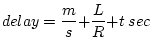
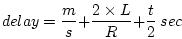
CS 2321 Solutions to Laboratory Problem Set 1

  1. Problem 1.46


    \begin{displaymath}Time for~\frac{1}{2}~revolution = \frac{1}{2}~rev \times \fra...
...
\frac{minutes}{rev} \times 60~\frac{seconds}{minute} = 4.17 ms\end{displaymath}


    \begin{displaymath}Time for~\frac{1}{2}~revolution = \frac{1}{2}~rev \times \fra...
...0}~
\frac{minutes}{rev} \times 60~\frac{seconds}{minute} = 3 ms\end{displaymath}

  2. Problem 1.47 DVD drives use Constant Linear Velocity (CLV) recording. The inner track stores:


    \begin{displaymath}1350000 \frac{bytes}{sec} \times 60 \frac{sec}{min} \times \frac{1}{1600} \frac{min}{rot} = 50625 \frac{bytes}{rot} \end{displaymath}

    The outer track stores:


    \begin{displaymath}1350000 \frac{bytes}{sec} \times 60 \frac{sec}{min} \times \frac{1}{570} \frac{min}{rot} = 142105 \frac{bytes}{rot} \end{displaymath}

  3. Problem 1.48


    \begin{displaymath}30 \frac{requests}{sec} \times 64 \times 1024 \frac{bytes}{request} \times 8 \frac{bits}{byte} = 15728640 \frac{bits}{sec} \end{displaymath}

    which can be handled by a 100 Mbit Ethernet link.

  4. Problem 1.50

  5. Problem 1.51 The incremental cost of each wafer is:


    \begin{displaymath}wafer\ cost = \$6000 + 0.5 \times 1500 \times \$10 = \$13500 \end{displaymath}

    The income from each wafer is:


    \begin{displaymath}wafer\ income = 1.4 \times 0.9 \times wafercost = \$17010 \end{displaymath}

    The wafer income is approximate because the problem does not indicate whether or not the 90% test yield should be included be included in the wafer income.

    The fixed cost of $500000 requires that $ \frac{\$500000}{ \$17010 - \$13500} = 142.45 $ wafers be built to break even. One cannot build a fraction of a wafer, hence,
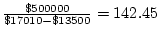


    \begin{displaymath}143 \times 0.9 \times 0.5 \times 1500 = 96525 \ chips \end{displaymath}

    must be fabricated to break even.

  6. Problem 1.52

    \begin{displaymath}Performance = \frac{1}{Execution \ Time} \end{displaymath}


    \begin{displaymath}Performance_{CISC} = \frac{1}{P \frac{CISC\ inst}{1} \times 8...
...s T \frac{ns}{CISC\ inst}} = \frac{1}{P \times 8 \times T\ ns} \end{displaymath}

    and


    \begin{displaymath}Performance_{RISC} = \frac{1}{2 \times P \frac{RISC\ inst}{1}...
...s T \frac{ns}{RISC\ inst}} = \frac{1}{P \times 4 \times T\ ns} \end{displaymath}

    Hence,


    \begin{displaymath}\frac{ Performance_{RISC}}{ Performance_{CISC}} = \frac{\frac...
... = \frac{P \times 8 \times T\ ns}{P \times 4 \times T\ ns} = 2 \end{displaymath}

    so the RISC machine has a higher performance by a factor of 2 when running the given program.

  7. Problem 1.53 In the analysis below, we ignore the fact that when an ethernet becomes saturated (i.e. collisions begin occuring), additional overhead (of resolving the collisions) consumes some of the available bandwidth.

    When 5 computers are connected by a hub on a 10 Mbps ethernet, all the computers share the 10 Mbps bandwidth. When the same 5 computers are connected by a switch on a 10 Mbps ethernet, any two computers on the switch may communicate with each other without affecting the other computers on the switch. We want to download a 10MB (byte) file( $10MB = 80Mb$) from another network. We must assume that the other network (where the remote server is located) is plugged into either the hub or the switch. In the case of the hub, the inbound file consumes bandwidth on the hub, while in the case of the switch, the inbound file does not affect transfers between the other machines on the switch.

    We also assume that the traffic between the other machines does not involve the machine downloading the 10MB file.

    1. hub

      \begin{displaymath}time(sec) = \frac{total\ transfers(Mb)}{bandwidth(Mbps)} = \frac{80Mb}{10Mbps - 4 \times 2Mbps} = 40sec \end{displaymath}

    2. switch

      \begin{displaymath}time(sec) = \frac{total\ transfers(Mb)}{bandwidth(Mbps)} = \frac{80Mb}{10Mbps} = 8sec \end{displaymath}


2006-01-27