This page shows the results of high resolution simulations of Saturn's A ring with embedded moonlets. The point of these simulations is to try to figure out what Cassini is seeing in observations that appears as bright regions in both lit and dark side images of the rings. Our earlier work showed that adding in self-gravity and particle size distributions makes it harder for the standard propeller structures to form. This work is doing higher resolution simulations and also looking at radiative transfer modeling of the system to see how the simulated systems would look in different conditions.
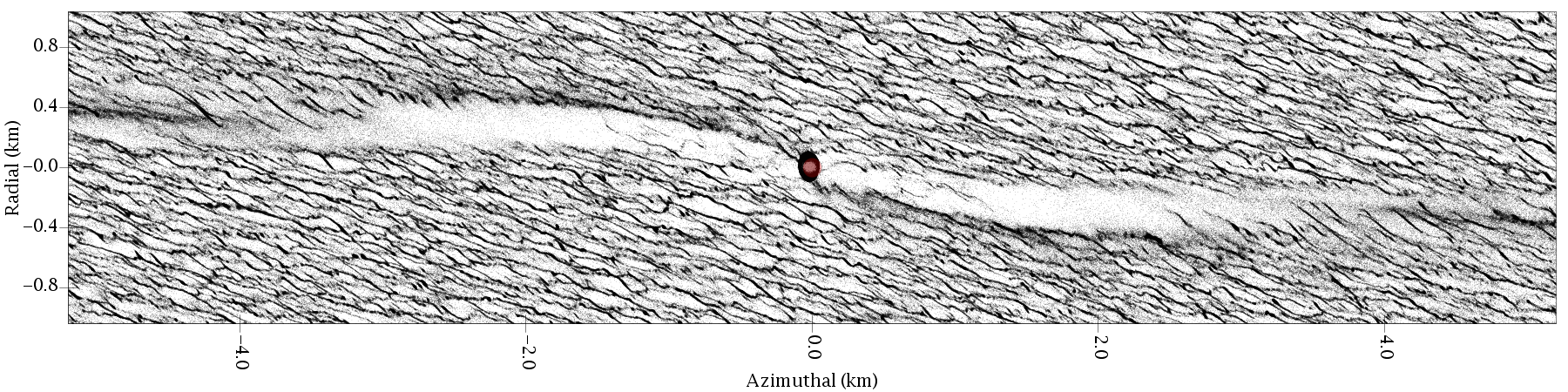
Here is an example of this. This first image shows a rendering of the section of the simulation near the moonlet where each particle has been drawn as a dot of the proper size. You can see the gravity wakes as well as both a gap formed by the moonlet and some slight density enhancements that are called moonlet wakes. Note that the moonlet is drawn lighter colored and there is a transparent red circle drawn that is the size of the original moonlet. This allows us to see how much of the background material has built up on the moonet.
This isn't exactly what would be seen by a spacecraft like Cassini though. It is more like an ideal image of the system. In reality, light comes in and gets scattered around and some of it makes it to the camera. The figure below uses a first order RT model. This model does not include light scattering, only shadowing. The camera here is on the unlit side of the rings. Note that there are bright regions to the left and the right, but both are below (radially interior to) the moonlet and their radial separation is smaller than the separation between the moonlet wakes.
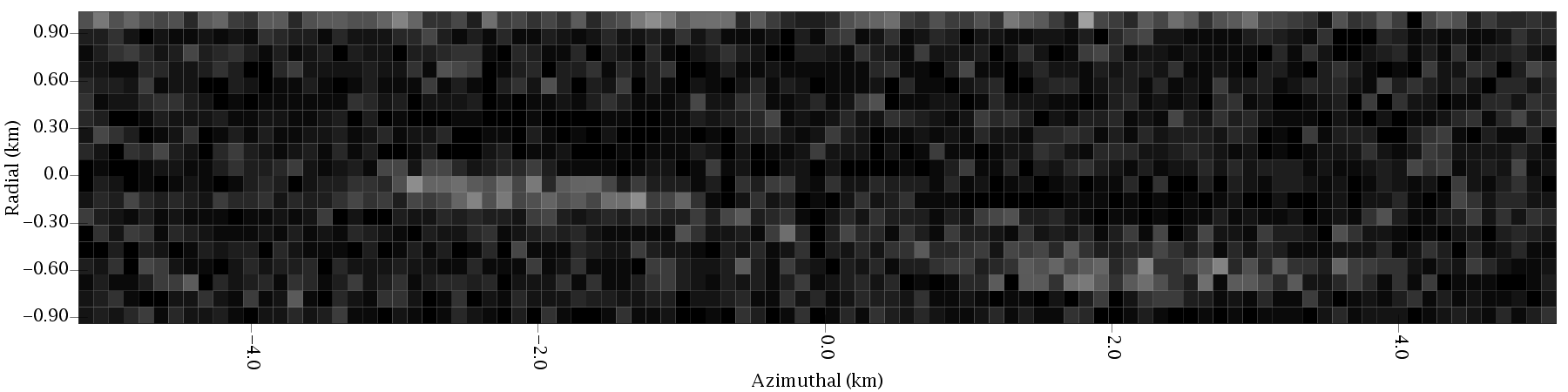
This has interesting implications for interpretation of Cassini images because radial separation is the primary measurement used to infer moonlet size. What is also interesting to note is that this viewing geometry was picked with care. Many viewing geometries showed nothing at all. Others, particularly on the lit side, showed the gaps very clearly. This one happened to do the best job of matching what is seen in observations. The intention of this work is to do sampling from many viewing geometries using a better RT model and also do it on many simulations. This particular simulation has a large moonlet, 130m in diameter. Many of the observations have features that lead us to infer a smaller size so a variety of moonlet sizes will also be used and compared.
Crosby Burdon, one of my research students funded by the NSF, has been spending the summer working on a few problems including this one. I have had him working on the basic question of what we see when we find propellers in the rings. There are four basic hypotheses that we are considering.
There are a few different ways that we are looking at these simulations that are shown here. The simplest is just doing a scatter plot of the particles, drawing them to the proper size. We also often color them based on something like their elevation above or below the plane. In addition to this, we make plots of binned data where we take the maximum z value to see how far material is being thrown out of the plane. The last type of plots shown in this section do ray tracing like the figure above, but with higher resolution. This gives us an idea of what might actually be seen if these systems were observed. This is an example of the latter two as an image.
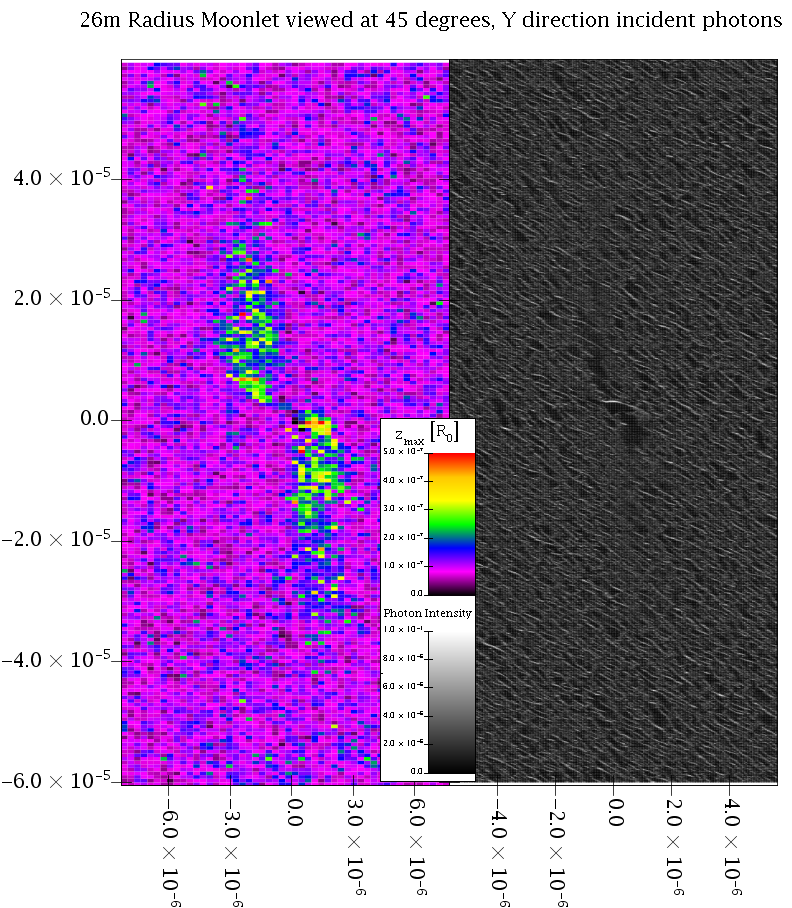
This image is of a simulation with background particles 1.3 m in radius and a moonlet 26 m in radius. They have an internal density of .5 g/cm^3 and there is a surface density of 40 g/cm^2. In this figure the light is coming from below at 5 degrees above the plane. The viewer is above the plane looking from the side at an elevation of 45 degrees off to the right.
This table shows different simulations and plot styles. The links go to movies. For the ray tracing, we recommend that you watch them standing far from your screen. This gives you a resolution more similar to what Cassini actually sees. The movies were made with mencoder using the xvid codec. If you have problems, try using Mplayer.
| Moonlet Radius [m] | Background Radii [m] | Internal Density (background/moonlet) [g/cm^3] | Surface Density [g/cm^2] | Scatter Plot | Ray Trace Plots |
| 13 | 1.3 | 0.5/0.8 | 40 | Movie | View 45 degrees X, Light 10 degrees X |
| 26 | 1.3 | 0.5/0.8 | 40 | Movie |
View 20 degrees X, Light 10 degrees X View 45 degrees X, Light 10 degrees X |
| 65 | 1.3 | 0.5/0.8 | 40 | Movie |