Accounting Updates on "Core Earnings" Theory and Implementation
Bob Jensen at Trinity University
Bob Jensen's threads on accounting theory are at http://www.trinity.edu/rjensen/theory.htm
Bob Jensen's Threads on Return on Business Valuation, Business
Combinations,
Investment (ROI), and Pro Forma Financial Reporting ---
http://www.trinity.edu/rjensen/roi.htm
Bob Jensen's Threads on "Core Earnings" Theory and Implementation
S&P Main Core Earnings Site (including a Flash Presentation) --- http://snipurl.com/SPCoreEarnings
S&P PowerPoint Show on Core Earnings
http://www.trinity.edu/rjensen//theory/00overview/corePowerpoint.ppt
http://www.trinity.edu/rjensen//theory/00overview/corePowerpoint.htm
Other Related Core Earnings Files
Bob Jensen's Overview --- http://www.trinity.edu/rjensen//theory/00overview/CoreEarnings.htm
Updates, including FAS 133 --- http://www.trinity.edu/rjensen//theory/00overview/CoreEarningsMisc.pdf
Pensions and Pension Interest --- http://www.trinity.edu/rjensen//theory/00overview/CoreEarningsPensions.pdf
CoreEarningsOilGas.xls Excel Workbook at http://www.cs.trinity.edu/~rjensen/theory/00overview/
Question:
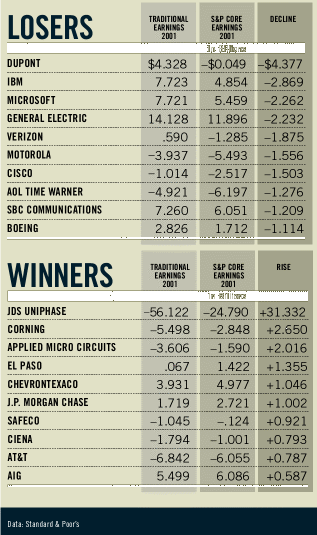
What ten companies have the
most "inflated" measures of profit?
Answer:
"Shining A New Light on
Earnings, BusinessWeek Editorial, June 21, 2002 --- http://www.standardandpoors.com/Forum/MarketAnalysis/coreEarnings/Articles/062102_coredata.html
How much does a company truly make? It's hard to tell these days. To boost the performance of their stocks, companies have come up with a slew of self-defined "pro forma" numbers that put their financials in a favorable light. Now ratings agency Standard & Poor's has devised a truer measure known as Core Earnings.
The Goal: to provide a standardized definition of the profits produced by a company's ongiong operations. Of the three main changes from more traditional measures of profits two reduce earmings: Income from pension funds is excluded and the cost of stock options are deducted as an expense. The other big change boosts earnings by adding back in the charges taken to adjust for overpriced acquisitions. Here are the top 10 losers and winners under Core Earnings:
April 7, 2003 message from Potter, Renee [renee_potter@standardandpoors.com]
Dear Professor Jensen,
I have attached a file containing the companies currently listed in the Oil & Gas Refining & Marketing & Transportation GICS sub- industry. This sub-industry (#10102030) is defined as those companies engaged in the refining, marketing and/or transportation of oil and gas products not classified in the Integrated Oil & Gas sub-industry.
Separately, I have attached a Power Point presentation that represents the points David Blitzer speaks about in his presentation.
Please feel free to source our Standard & Poor's Compustat database in your presentation. Additionally, we would appreciate if you would refer to our methodology as "Standard & Poor's Core Earnings," so as not to be confused with other definitions that maybe out in the marketplace.
Feel free to contact me regarding any additional materials or questions about the data.
We look forward to hearing how your presentation went.
Sincerely,
Renee Potter
The "Core Earnings" financial statement revisions from Standard & Poor's
(Compustat) are intended make corporate financial statements more comparable
between different companies that choose alternative accounting policies that
make comparisons extremely difficult to compare continuing "core" operations. http://www2.standardandpoors.com/NASApp/cs/ContentServer?pagename=sp/Page/PressSpecialCoveragePg&b=5&r=1&s=3&ig=1026841911315
I
also created the shorter URL --- http://snurl.com/CoreEarnings
In response to growing concern about companies earnings reports, Standard & Poor’s has introduced a new methodology called “Standard & Poor’s Core Earnings.” The ultimate goal is to lead investors and analysts to a consensus on earnings calculations, and bring more transparency and consistency to earnings analysis and forecasts.
Included in Standard & Poor's definition of Core Earnings are the following:
Excluded from this definition are the following:
From "Core Earnings: Towards A New Dawn," Capital Ideas, January 20, 2003 --- http://www.capitalideasonline.com/suneetsingh/core_earnings.htm
There are three key items included in the calculation of core earnings, which have been the subject of lot of debate in the financial community:
Employee stock option grant expense
Stock options are granted to employees as part of their compensation packages. Other components of compensation include salaries, cash bonuses based on individual or corporate performance, medical and other employee benefits, and defined benefit and/or defined contribution pension plans. S&P believes that all parts of employee compensation, including stock options, should be included in Core Earnings. Many companies (particularly in the IT sector) donot include this item as an expense. The legendary investor Warren Buffett has gone on record saying that companies excluding this item are trying to project a skewed picture of operations to the investors. Stock options are a form of compensation and must be included in the calculation of earnings. S&P attempts to correct this lacunae with the inclusion of this item in the calculation of Core Earnings.
Restructuring charges from on-going operations
Standard & Poor’s believes restructuring charges from on-going operations should be included in the calculation of Core Earnings because they relate to the costs and expenses of activities involved in the process of creating products or services. Restructuring charges from on-going operations are generally defined as those expenses, such as employee layoffs, maintenance costs, or early lease terminations that arise when a company decides to close plants or other facilities. Since these assets would have been used up in the process of creating operating revenues, charges for restructuring these assets should be included in the calculation of Core Earnings.
Pension costs
Pensions are part of employee compensation, just like salaries, bonuses, benefits, employee stock option grants, and other forms; pension costs are contributions to the pension trust. Since pensions costs are obligations borne by the company, and thus by its shareholders, these costs should be included in Core Earnings.
The basic difference between the key metrics is highlighted in the table below:
Stock Option Expense Net Pension Income Restructuring Charges Source: S&P
According to S&P, General Motors would have posted a loss of $4.21 a share for the year ended June 30 2002 compared with GAAP earnings of $3.21, while DuPont would have suffered a loss of 27 cents a share vs. GAAP earnings of $4.96. Similarly, Cisco would have posted core earnings of 13 cents a share for the year ended June 30 2002 vs. reported earnings of 25 cents. The significance of Core Earnings to the investor is but obvious.
S&P aims to use the new metric in the following ways:
- Equity analysts will consider Core Earnings when they analyze and review stocks. S&P plans to use this metric as one of most important criterion to judge the performance of a company
- S&P plans to begin calculating Core Earnings per share for U.S. indices and the main sectors in those indices.
Third, supporting data will be in Standard & Poor's COMPUSTAT database for use by the investment community
- Standard & Poor's will use Core Earnings as part of its debt rating activities
The market has been divided over the relevance of this new metric. Some believe that this is just old wine in a new bottle. Some believe that although the spirit of what S&P is doing is commendable, yet the exact calculations and interpretation of the metric leaves a lot to be desired. Despite the controversy over the new metric, 110 companies have agreed to adhere to this metric. Out of these 110 companies, 58 companies represent one fourth of the market capitalization of the S&P500.
The biggest rule in financial markets is that of trust: trust in the management, trust in the information published by companies and trust in the expert opinion to make investment decisions. No metric be it operating, proforma or GAAP earnings can help to evaluate the true worth of the business if the intention of the guardians of the business is to take the investors for a ride. The core earnings is a step in the right direction. But ultimately the onus lies with the guardians of the business to regain the lost faith and trust of the investor community.
Standard & Poor's Core Earnings Figures Released for the S&P 500
New York, October 24, 2002 –Standard & Poor's, the independent financial research and ratings leader, today announced that Standard & Poor’s Core Earnings for the S&P 500 Index for the 12 months ended June 2002 were $18.48 per share compared to as-reported earnings per share (EPS) of $26.74.* Standard & Poor’s Core Earnings were also released for all S&P 500 companies and 10 industry sectors.
Standard & Poor's Core Earnings focuses on a company’s after-tax earnings generated from its principal businesses. Standard & Poor's examination of the S&P 500 data showed that pension incomes and stock option grant expenses are largely responsible for the differential between Standard & Poor's Core Earnings and as-reported earnings. Standard & Poor's found that the treatment of pension gains in particular had a significant impact. Standard & Poor's Core Earnings adjustment to as-reported earnings for pension income amounted to $6.54 per share and most heavily impacted companies in the telecommunications and industrials sectors.
Stock option grant expenses, an issue already being addressed by the FASB, accounted for $5.21 per share in additional expense from the S&P 500 as-reported numbers over the same period. In comparing the effect of options across S&P 500 sectors, Standard & Poor's found that they had the greatest impact on technology companies. For a more detailed report on options and pensions accounting as well as a sector review, see Standard & Poor's Market Review available on http://www.coreearnings.com/ . “The treatments of pensions and stock option expenses are by far the most significant factors accounting for the difference between Standard & Poor's Core Earnings and as-reported figures,” commented David Blitzer, managing director of Quantitative Services. “Our analysis of pension accounting shows that its impact is equally as, and in some cases more, significant than options. We believe that this pension effect must be examined to make a meaningful assessment of a company's financial performance."
|
In response to growing concern about companies earnings reports, Standard & Poor’s has introduced a new methodology called “Standard & Poor’s Core Earnings.” The ultimate goal is to lead investors and analysts to a consensus on earnings calculations, and bring more transparency and consistency to earnings analysis and forecasts. If you have comments or inquiries about Standard & Poor's Core Earnings and the related products and services, please contact us at clientsupport@standardandpoors.com 800-523-4534 (8am-8pm EST).
Standard & Poor's Core Earnings values beginning 1st quarter 2001 and beyond are now available for the S&P 400, S&P 500 and S&P 600. For all other U.S. companies in the Standard & Poor's Compustat® database, values will be available in 2003. Five-year historical values for the S&P 500 will also be available in 2003, and going forward the Standard & Poor's Core Earnings values will be available simultaneously with the company's 10K & 10Q updates in the Compustat database. Additionally, Standard & Poor's Core Earnings values will be reflected in Stock Reports in early 2003. If you receive Standard & Poor's Compustat data via a third-party vendor, please contact them directly for the expected availability date of Standard & Poor's Core Earnings data. Click here for more information about Standard & Poor's Equity Research. Standard & Poor's Core Earnings refers to earnings calculations that are both: (1) based on the Standard & Poor's Core Earnings methodology; and (2) calculated by Standard & Poor's with the use of that methodology. Any statement of Standard & Poor's Core Earnings should be identified as: Standard & Poor's Core Earnings calculated by Standard & Poor's. Any calculation of purported core earnings (whether or not based on Standard & Poor's Core Earnings methodology) not calculated by Standard & Poor's may not be referred to as Standard & Poor's Core Earnings. "Standard & Poor's Core Earnings" is a trademark of The McGraw-Hill Companies, Inc.
|
| ||||||||||||||||||||||||||||||||||||||||||||||||||||||||||||||||||||||||||||||||||||||||||||||||||||||||||||||||||||||||||||||||||||||||||||||||||||||||||||||||||||||||||||||||||||||||||||||||||||||||||||||||||||||||||||||||||||||||||||||||||||||||||||||||||||||||||||||||||||||||||||||||||||||||||||||||||||||||||||||||||||||||||||||||||||||||||||||||||||||||||||||||||||||||||||||||||||||||||||||||||||||||||||||||||||||||||||||||||||||||||||||||||||||||||||||||||||||||||||||||||||||||||||||||||||||||||||||||||||||||||||||||||||||||||||||||||||||||||||||||||||||||||||||||||||||||||||||||||||||||||||
Some Related Links
Standard and Poor's Core Earnings Technical Bulletin --- http://www.businessweek.com/pdfs/2002/sptech.pdf
StockOpeions
Bob Jensen's threads on FAS 123 --- http://www.trinity.edu/rjensen/theory/sfas123/jensen01.htm
Timothy
A. Luehrman's Slide Show --- http://www.mcgraw-hill.govtservices.com/symposium2002/2003/Luehrman_files/frame.htm
Pensions, Pension Interest and Standard & Poor's Core Earnings --- http://www.public.asu.edu/~bac524/pensioncostcoreearnings.pdf
Defined Benefits, Loose Accounting --- http://www.cfo.com/Article?article=7224
S&P Core Earnings Sheds Light on Pension Fund Accounting --- http://classwork.busadm.mu.edu/classwork/Giacomino/ACCO%20140&%20ACCO%20240/S&P%20EPS%20Comp.html
Inside S&P's Core Earnings --- http://www.fmnonline.com/publishing/article.cfm?article_id=720
2001 S&P Core Earnings --- http://bwnt.businessweek.com/core_earnings/2001/index.asp
S&P's Core Earnings, AOL, and Active Funds --- http://www.fool.com/news/take/2002/take021024.htm
Faith in the Bottom-Line How do you know if a company's earnings are on the level? Sometimes you don't. That's why Standard & Poor's has a new approach: 'core earnings.' FORTUNE Tuesday, May 14, 2002 --- http://www.fortune.com/fortune/investing/articles/0,15114,369475,00.html
Core Earnings: A Better Measure --- http://m1.mny.co.za/cfacc.nsf/Current/C2256B5E003F4C8042256BF5001C43C9?OpenDocument
FEI Questions Relevance of New S&P Core Earnings Measure --- http://www.smartpros.com/x34133.xml
FEI concerns with S&P's core earnings measure include:
- Employee benefit costs included in S&P's core earnings do not reflect the funding status of benefit plans. Accordingly, companies in vastly different positions relative to future payment obligations would look the same to investors.
- Asset write-downs are included in core earnings but gains/losses on asset sales are not. Because reversals of accounting write-downs are prohibited under GAAP, the proposed measure introduces a significant negative bias to the measure of core earnings.
- Stock compensation expense is deducted from S&P's core earnings measure based on pro-forma information provided by companies under GAAP. FEI notes that leading valuation experts have criticized the use of market-based option pricing models to value employee stock options.
- S&P measure excludes one-time gains but not one-time losses (e.g., restructuring). The inconsistency of this treatment is hard to understand. Furthermore, the decision of whether gains are recurring or "one-time" is highly subjective.