|
1
|
|
|
2
|
- What it is
- Why we publish Standard & Poor’s Core Earnings
- How it’s defined
- Plans for Standard & Poor’s Core Earnings
|
|
3
|
- Standard & Poor’s Core Earnings is supported by Standard &
Poor’s three major units:
- Developed by Investment Services
- Prepared in consultation with Corporate Value Consulting
- Utilized by Credit Market Services as part of its debt analysis
|
|
4
|
- Standard & Poor’s Core Earnings is
- a standardized calculation of earnings from a company’s core business,
designed to capture long-term true earnings power of the business
|
|
5
|
- Investors want an earnings measure they understand and trust. Without
any definition of earnings measures, there is no consistency across
companies or through time.
- Standard & Poor’s recognized that inconsistency and confusion were
hurting investor confidence.
- Just calling for change was not enough – someone had to propose a
definition, listen to comments and build a consensus.
- Standard & Poor’s has stepped up.
|
|
6
|
- Concerns about GAAP:
- GAAP net income doesn’t tell the whole story.
- GAAP lets companies write their own definitions for operating earnings.
- GAAP tries to be all things to all people.
- Standard & Poor’s response:
- Standard & Poor’s Core Earnings targets a company’s core business.
- Standard & Poor’s Core Earnings focuses on consistent comparisons.
- Standard & Poor’s Core Earnings is used in investment analysis.
|
|
7
|
- Unlike GAAP, Standard & Poor’s Core Earnings does not smooth out the
volatility that is really present in earnings and operations. However,
the Standard & Poor’s Core Earnings history we have developed will
mute that volatility. In addition, we have provided guidance on how
investment managers can easily take pension interest costs – i.e.,
market-induced volatility – out of the Standard & Poor’s Core
Earnings calculation.
|
|
8
|
- Standard & Poor’s supports analysis using Standard & Poor’s Core
Earnings:
- Data in Standard & Poor’s Compustat
- Recognition of the S&P 500
- Analysis that will be added in Standard & Poor’s Stock Reports and
other Standard & Poor’s services for brokers, analysts and
institutional investors
- Standard & Poor’s is an independent source of analysis, information
and data; Standard & Poor’s does not have apparent or potential
conflicts.
|
|
9
|
- Begin with as-reported earnings, a widely used measure defined with GAAP
- Make adjustments to focus on the company’s core business
- As-reported EPS is GAAP net income excluding discontinued operations and
extraordinary items.
- It is the longest time series for S&P 500 EPS, extending back over
decades.
|
|
10
|
|
|
11
|
|
|
12
|
- Standard & Poor’s is not rewriting GAAP or trying to do FASB’s job.
- Standard & Poor’s is not suggesting new SEC regulations or new
legislation.
- We are using existing accounting and reporting concepts to give
investors and analysts a better understanding and more complete
information about companies.
|
|
13
|
- Stock options are compensation, just like wages, salaries and benefits.
Therefore:
- Expenses related to stock option grants should be treated like other
compensation costs in calculating earnings.
- Expenses should be reported quarterly rather than annually.
- Employee stock option grant expense is included in Standard & Poor’s
Core Earnings.
- Standard & Poor’s takes no position on the tax treatment of stock
option grants.
|
|
14
|
|
|
15
|
- Net pension gains (pension income after pension-related expenses) are
funds held in a trust for retirees and future retirees. These gains are not corporate funds.
Therefore, net pension gains should not be included in Standard &
Poor’s Core Earnings.
- Pension expenses include service costs and interest costs:
- Service costs are deferred compensation, representing the benefits that
accrue from the current year’s labor services.
- Interest costs are financing costs, reflecting the passage of time as
the moment when benefits will be paid draws closer.
- These costs should be covered by the pension fund. Specifically, the
actual return on pension plan assets should cover interest costs.
|
|
16
|
- For Standard & Poor’s Core Earnings, pension costs include:
- Service costs
- Interest costs to the extent that they are not covered by actual
returns on plan assets
- Because any pension gains become part of the pension fund assets for the
benefit of retirees and employees, these are not corporate funds and are
not part of Standard & Poor’s Core Earnings.
- Companies do not benefit from funds reserved for pension beneficiaries.
- However, pension plan assets can, actual returns permitting, cover
pension interest expense.
|
|
17
|
- Interest costs are charges in years when the pension plan makes little
money. Doesn’t this make earnings very volatile?
- It can have that effect. Interest costs are real costs and, if the
pension plan returns can’t cover these costs, the company is
responsible.
|
|
18
|
- How does FASB treat interest costs?
- FASB looks to the pension plan first to cover interest costs, as
Standard & Poor’s Core Earnings does. Then FASB uses expected
returns rather than actual returns. While the expected returns
eliminate the volatility, they also obscure the true impact of pensions
on earnings. An important note:
Pension interest charges this year can be a warning that a
company’s cash flow and net earnings next year could be reduced by a
required contribution to its pension fund.
|
|
19
|
- Is there another way to measure pension costs without making earnings
volatile?
- As long as one wants a year-by-year measure of the true earnings, the
volatility will be there. However, in most years, actual pension gains
cover most or all of the interest costs. For analysts who want to make
other adjustments, such as using a multi-year moving average, Standard
& Poor’s Core Earnings data show pension interest as a separate
item. It is easy with Standard & Poor’s data to take this cost out
of Standard & Poor’s Core Earnings for each company and each of our
indices.
- If the S&P 500 is up 7.8% in 2003, Standard & Poor’s estimates,
there will be no pension interest costs charged against Standard &
Poor’s Core Earnings for the S&P 500.
|
|
20
|
- Operating earnings often exclude restructuring charges that are part of
ongoing operations.
- GAAP defines discontinued operations.
- Charges that are not related to discontinued operations should be
included in Standard & Poor’s Core Earnings.
- If a company subsequently reverses a prior provision, that reversal is
not credited to Standard & Poor’s Core Earnings.
|
|
21
|
- Discussed in detail in the white paper published in May 2002 and the
Technical Bulletin published in October 2002
- Available at www.standardandpoors.com
|
|
22
|
- Standard & Poor’s Core Earnings and detailed information will be
provided in Compustat.
- Standard & Poor’s will continue to publish and use as-reported and
operating data for the S&P 500 and our other indices, in addition to
Standard & Poor’s Core Earnings.
- We will forecast Standard & Poor’s Core Earnings for companies we
follow analytically through our Equity Research Department.
|
|
23
|
- S&P 500 earnings measures compared
- Table showing as-reported earnings and Standard & Poor’s Core
Earnings for the S&P 500, and the pension interest costs
- Table showing Standard & Poor’s Core Earnings for GICS Sectors in
the S&P 500 (per share data)
- Table showing Standard & Poor’s Core Earnings for GICS Sectors in
the S&P 500 (return on sales data)
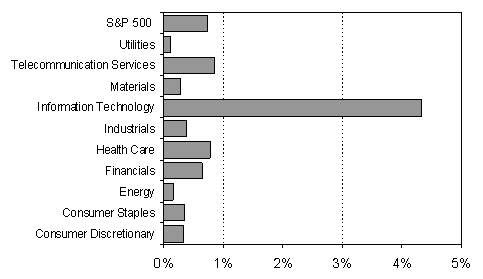
- Chart showing option expense by GICS Sector for the S&P 500
- Chart showing pension adjustments by GICS Sector for the S&P 500
|
|
24
|
|
|
25
|
|
|
26
|
|
|
27
|
|
|
28
|
|
|
29
|
|
|
30
|
- Standard & Poor’s will continue to work with key leaders in the
investment community to develop consensus to support more informative
and accurate earnings information.
- Standard & Poor’s will support Standard & Poor’s Core
Earnings with data and analysis,
including full data in Compustat, EPS data on indices, forward EPS
estimates on over 1,200 companies in Standard & Poor’s equity
analytical universe, and other efforts.
- Standard & Poor’s CVC will provide assistance to corporations in the
use of Standard & Poor’s Core Earnings in their financial reporting.
|
|
31
|
- 800-523-4534
- www.standardandpoors.com
- www.coreearnings.com
- Core_earnings@standardandpoors.com
|

 Notes
Notes