 |
 |
 |
 |
 | |
 | |||||

Complying with FAS 133
Accounting Solutions in Finance KIT
During the past year Trema has worked with clients, partners and consulting firms to ensure that all Finance KIT users will be FAS 133 compliant by Summer 2000, when the new U.S. accounting standards come into effect. In Finance Line 3/99, Ms. Mona Henriksson, Director of Trema (EMEA), addressed the widespread implications the FAS 133 accounting procedures will have on the financial industry (see ‘Living Up to FAS 133’ in Finance Line 3/99). Now, in this issue, Ms. Marjon van den Broek, Vice President, Knowledge Center – Trema (Americas), addresses specific FAS 133 requirements and their corresponding functionality in Finance KIT.
As stated in paragraph 3(b) of the June 1998 Statement of Financial Accounting Standards No. 133:
Fair value is the most relevant measure for financial instruments and the only relevant measure for derivative instruments. Derivative instruments should be measured at fair value, and adjustments to the carrying amount of hedged items should reflect changes in their fair value (that is, gains and losses) that are attributable to the risk being hedged and that arise while the hedge is in effect.
In order to measure financial instruments based on their fair value, a system is required to calculate the value of the instrument based on current market rates. The market valuation of financial instruments has been one of Finance KIT’s core principles since the very beginning.
According to Finance KIT’s market valuation principle, all transactions are subject to market valuation as soon as they are entered into Finance KIT. This means that based on the market valuation, all result and risk figures relevant to the transaction can immediately be calculated allowing you to monitor or use them directly in real-time monitoring tools, various reports and, most importantly, for accounting. The exact method used in market valuation is defined separately for each instrument, but in general it is based on individual cashflows. Finance KIT breaks down each transaction into cashflows, then – by discounting using the appropriate valuation method – the market value is calculated for each cashflow. The sum of the market value for each individual cashflow of a transaction, gives the market value of that transaction. It is also possible to calculate the market value of each individual cashflow by, for example, leg or cashflow type. This is necessary when the market value is needed for only one leg of an interest rate swap or for only the interest cashflows of a transaction and not the principal cashflows.
In order to adjust the carrying amount of the hedged item with the changes in fair value (gains and losses) that are attributable to the risk being hedged, it is necessary to split the gains and losses into different components. In other words, which part of the gain or loss is caused by changes in the interest rates, which is caused by changes in the foreign exchange rates etc. This split is made in Finance KIT as the change in market value is represented by three separate key-figures; (Un)realized FX Result, (Un)realized IR result and Accrued Interest, where (Un)realized FX result is the market value change caused by changes in the foreign exchange rates, and (Un)realized IR result is the market value changes caused by changes in the interest rates.
Intrinsic Value and Time
Value
…This statement permits (but does not require) an
entity to exclude all or part of the hedging instrument’s time value from
the assessment of hedge effectiveness… (Paragraph 63)
In order to exclude the time value from the effectiveness test, it is essential that the market value be split into intrinsic and time value. Therefore, there are two new key-figures for accounting and effectiveness tests, namely Intrinsic Value and Time Value, where Time Value = Market Value – Intrinsic Value.
Hedging RelationshipAt inception of the hedge, the hedging relationship must be created in Finance KIT. FASB requires the following:
At inception of the hedge, there is formal documentation of the hedging relationship and the entity’s risk management objective and strategy for undertaking the hedge, including identification of the hedging instrument, the hedged item, the nature of the risk being hedged, and how the hedging instrument’s effectiveness in offsetting the exposure to changes in the hedge item’s fair value attributable to the hedged risk will be assessed. There must be a reasonable basis for how the entity plans to assess the hedging instrument’s effectiveness. (Paragraph 20(a) & 28(a))
Finance KIT summarizes this information in one central place, Hedge Relation Editor, see figures 1 and 2. This editor is used to create each individual hedging relationship, i.e. the link between the hedged item(s) and the hedged transaction(s) designated as the hedge, and entered into Finance KIT. The information required by FASB is, in a summarized version, also mandatory when creating the hedging relationship in Finance KIT.
The following fields must be defined for each hedging relationship:
Hedge strategy code.
The hedge
strategy code refers to the risk management objective and strategy for
undertaking the hedge. Typically the different hedge strategies are
formally documented and the reference code refers to this documentation.
The strategy code can also be used in the accounting rules, and can
therefore steer the entries based on the hedge strategy.
Hedge risk type and hedge
type.
The hedge risk type and the hedge type indicate the
nature of the risk being hedged. The hedge risk type is, for example, IR
or FX exposure and the hedge types are fair value hedge, cashflow hedge
and net investment hedge. The ‘from when’ and ‘to when’ dates can be
indicated for the hedge types, as it is possible that a hedging
relationship is initially a cashflow hedge but later becomes a fair value
hedge. For example, the hedge of a forecasted cashflow can become a hedge
of a firm commitment when the invoice is sent out.
Prospective and retrospective effectiveness
assessment.
The basis for how the user plans to assess the
hedging instrument’s effectiveness throughout the life of the hedging
relationship and during the past, is entered into the prospective and
retrospective effectiveness assessment fields (see Figure
1).
…Two or more derivatives, or proportions thereof, may also be viewed in combination and jointly designated as the hedging instrument…(Paragraph 18)
Designation. More then one hedged item or hedging transaction can be designated to one hedging relationship. Furthermore, it is possible to only designate a percentage of the hedged item or the hedging transaction to the hedging relationship. Figure 2 displays two hedging transactions and only 75% of the hedged item designated to the hedging relationship.
In case any further properties or references to formal documentation is required this can be indicated in Hedge Relation Editor.

Hedge relation Editor 1
This Statement requires that an entity define at the time it designates a hedging relationship the method it will use to asses the hedge’s effectiveness in achieving offsetting changes in fair value or offsetting cashflows attributable to the risk being hedged. It also requires that an entity use that defined method consistently throughout the hedge period (a) to assess at inception of the hedge and on a ongoing basis whether it expects the hedging relationship to be highly effective in achieving offset and (b) to measure the ineffective part of the hedge. (Paragraph 62)
For each hedging relationship, the relevant hedge effectiveness test methods must be specified. The effectiveness test method used to prove expected hedge effectiveness, is defined in the Prospective Effectiveness Assessment field. The Retrospective Effectiveness Assessment specifies the method that is used to prove the effectiveness of the hedging relationship during the past period. The Retrospective Effectiveness Measurement is the effectiveness test method that is used to calculate the ineffective portion; this is the percentage that is also used for the hedge accounting.
Dollar Offset MethodThere are currently two hedge effectiveness tests available in Finance KIT; the cumulative dollar offset method and the periodic dollar offset method. The cumulative method is typically used for cashflow hedges and the periodic dollar offset method is typically used for a fair value hedge. The formulae used for these methods are displayed below.
Periodic dollar offset method:
Cumulative dollar offset method:

Where,
| = | accumulated daily change in the effectiveness key-figure of the hedge transaction(s) during the specified period | |
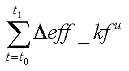 |
= | accumulated daily change in the effectiveness key-figure of the underlying transaction(s) during the specified period |
 |
= | accumulated daily change in the effectiveness key-figure of the hedge transaction(s) since the inception of the hedging relationship |
|
= | accumulated daily change in the effectiveness key-figure of the underlying transaction(s) since the inception of the hedging relationship |
The effectiveness key-figure is the key-figure that reflects the changes in fair value that are attributable to the risk being hedged, for example, Unrealized IR Result or Unrealized FX Result.
Short Cut Method
In case the hedging
relationship qualifies for the Short Cut method, this method will be
entered for the Retrospective effectiveness assessment and measurement.
Finance KIT will then automatically assume an effectiveness of 100%.
Calculate Effectiveness
The hedge
effectiveness can be calculated at any given point in time for any given
date using Activity Manager (Finance KIT’s batch job scheduler). The
results can be monitored in the Hedge Effectiveness Board, see
figure 3. As Finance KIT stores the effectiveness percentage for each
individual date for which the calculation has been made, the effectiveness
can be monitored for any given date in the past.
Hedge Effectiveness Board
Having calculated the hedge effectiveness percentage, Finance KIT will automatically indicate for each hedging relationship whether it qualifies for hedge accounting. The range that is used for the qualification (e.g. 80%-125%) is user-definable and can, for example, be adjusted in case another effectiveness test such as regression analysis is used (see Figure 3).
As indicated before, the outcome of the hedge effectiveness calculation is used for the accounting entries. Therefore, Finance KIT is designed so that it is mandatory for the user to accept the outcome before the accounting entries are made.
Hedge AccountingDerivative instruments represent rights or obligations that meet the definitions of assets or liabilities and should be reported in financial statements. (Paragraph 3(a))
As soon as a derivative instrument is traded is should be marked-to-market on the balance sheet and the unrealized result should be booked either to earnings or to other comprehensive income. The closing the books functionality in Finance KIT is used to book these kind of unrealized results, in fact, any key-figure can be booked, such as Market Value, Accrued Interest, Unrealized IR Profit/Loss, and Unrealized FX Gain/Loss (see Figure 4).
No hedging designation. The gain or loss on a derivative instrument not designated as a hedging instrument shall be recognized currently in earnings. (Paragraph 18(a))
Based on the above paragraph, FASB requires that institutions distinguish between transactions that are designated as a hedge, and transactions that are not designated as a hedge. If we look at this article in more detail, it is possible to designate a portion of one transaction to a hedging relationship, and it is required to split the unrealized figure of one transaction into a designated and a non-designated portion.
The effective portion of the gain or loss on a derivative designated as a cash flow hedge is reported in other comprehensive income, and the ineffective portion is reported in earnings. (Paragraph 30)
Based on this paragraph, we can conclude that a further split of the designated portion of the unrealized figure by effective and ineffective portion is necessary.
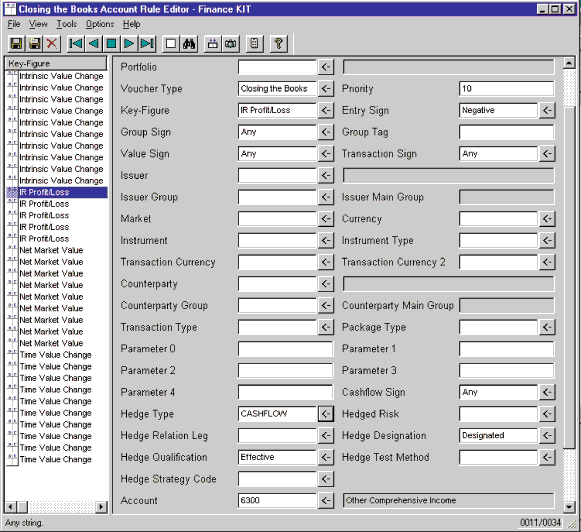
Finance KIT can split the key-figures by designated and undesignated portion based on the designation percentage entered in Hedge Relation Editor for each transaction that is part of a hedging relationship, and will further split the designated portion in an effective and ineffective portion based on the effectiveness percentage. Each of these different portions can then be mapped to different general ledger accounts. See Figure 4, Closing the Books Account Rule Editor. An example of how the journal entries appear is displayed in Figure 5.
Closing the Books Account Rule Editor
Closing the Books Report
Accumulated other comprehensive income associated with the hedged transaction shall be adjusted to a balance that reflects the lesser of the following (in absolute amount):
1) The cumulative gain or loss on the derivative from inception of the hedge less (a) the excluded component discussed in paragraph 30(a) above and (b) the derivative’s gains or losses previously reclassified from accumulated other comprehensive income into earnings.
2) The portion of the cumulative gain or loss on the derivative necessary to offset the cumulative change in expected future cash flows on the hedged transaction from inception of the hedge less the derivative’s gains or losses previously reclassified from accumulated other comprehensive income into earnings. (Paragraph 30(b))
This means that the maximum amount that can be booked in other comprehensive accounts is the lesser of cumulative gain or loss on the item, and the cumulative gain or loss on the derivative. If, for example, the derivative accumulates a gain of 11,000 since the inception of the hedge, and the item has a loss of 10,000, then the maximum amount allowed in other comprehensive income is 10,000. The ineffective portion of 1,000 must be booked in earnings. If for the next period the derivative accumulates a gain of 11,000 and the item a loss of 11,500, the maximum amount allowed in other comprehensive income is 11,000. Then the 1,000 initially booked in earnings will be reclassified into other comprehensive income. In order to comply with article 30b, Finance KIT calculates the maximum allowed in the other comprehensive account balance at the end of each day using the closing the books procedure, and makes correction bookings if necessary.
Reclassify Other Comprehensive Income into EarningsThe balance of the other comprehensive account is maintained separately for each hedging relationship in Finance KIT until it is reclassified into earnings.
Amounts in accumulated other comprehensive income shall be reclassified into earnings in the same period or periods during which the hedged forecasted transaction affects earnings (for example, when the forecasted sale actually occurs)… (Paragraph 31)
When other comprehensive income is released depends on the hedged item. When the hedged item affects earnings, the other comprehensive income should also affect earnings. Currently, Finance KIT provides four different methods for reclassifying other comprehensive income:
Immediate reclassification.
The
balance in other comprehensive income for a specific hedging relationship
is discharged immediately at the end date of the hedging relationship.
Reclassification on a specified
date.
The total balance in other comprehensive income for a
specific hedging relationship is discharged at a specific date in the
future. This is applied, for example, when hedging a forecasted sale in a
foreign currency with an FX option contract. If the expiration date of the
FX option contract is set at the invoice date of the sale, other
comprehensive income should not be discharged at the end date of the
hedging relationship but at the date that the actual cashflow resulting
from the sale is received (i.e. impacts earnings).
Reclassification over a specified
period.
The balance in other comprehensive income for a
specific hedging relationship gets discharged based on how the hedged item
impacts earnings, but the hedged item is not a financial instrument in
Finance KIT. This is the case, for example, when hedging an anticipated
purchase of an inventory and other comprehensive income should be
discharged based on the depreciation of that inventory. By setting the
discharge ‘from and to’ date to the ‘start and end’ date of the
depreciation period of the hedged inventory Finance KIT will gradually
(linear) reclassify the balance into earnings.
Reclassification according to
underlying.
The balance in other comprehensive income for a
specific hedging relationship gets discharged based on how the hedged item
impacts earnings, and the hedged item is a financial instrument in Finance
KIT. This will be applied, for example, when hedging the expected issuance
of a bond transaction; other comprehensive income will be released during
the life of the bond that has actually been issued.
Automatic
reclassification.
Specific actions do not need to be taken
to discharge other comprehensive income. For example, if an interest rate
swap is used to hedge a variable rate debt, the amount accumulated in
other comprehensive income is indirectly recognized in earnings as
periodic settlements of the swap occur and the fair value of the swap
declines to zero.
FAS133 Reporting
In order to fulfill the
demands from the auditors and to enable the user to keep track of all
hedging relationships, hedge effectiveness calculations and balances in
other comprehensive income, several reports are available:
Hedge Relation Report
As stated earlier
in this article Hedge Relation Editor contains, in a summarized version,
all the information required by FASB when creating a hedging relationship.
The Hedge Relation Report displays all this required information, for
example the effectiveness test methods, the hedge strategy, the start and
end date, the transactions that are part of the hedging relationship etc.
Effectiveness Calculation Report
The
Effectiveness Calculation Report allows you to calculate the hedge
effectiveness without saving the effectiveness percentages in the
database. Furthermore, it displays the components (per deal, per day) used
in calculating the actual effectiveness number. This can be used to check
the outcome of the effectiveness calculation first in a report before
saving the effectiveness percentage and qualification directly in the
database.
Hedge Effectiveness Report
Having run
the Hedge Effectiveness activity, the hedge effectiveness percentages and
the qualification are stored in the database. Besides monitoring the
results in Hedge Relation Board, the results can also be seen in the Hedge
Effectiveness Report. This report displays the calculated and applied
effectiveness numbers, and the qualifications that are saved in the
database for any required date, hedge strategy or hedging relationship. In
case the applied effectiveness percentage or the qualification has been
modified, the report will display the user ID of the user who has manually
made these changes.
The Account Balance Report provides the balance in other comprehensive income per hedging relationship and furthermore, a forecast of the amounts to be reclassified to earnings within the next 12 months.
Each report has a start-up window where you can specify which hedge strategy, hedging relationship, dates etc. you want to see in the report.
TOP PAGE
| CONTACT | SEARCH | SITEMAP | © | HOME