"Railway Economy"
by Dr. Dionysius Lardner (1850)
as "Intersect" of Absorption and Marginal Costings
ABSTRACT
Recent historians have ignored or undervalued this intelligent and well-informed study of railways built during the first half of the 19th century. Operations under state or investor control are contrasted with acute insight into the gains from full publicity. Intricate calculations are offered reflecting the costs of diverse activities, and pro-rating these costs with fairness to passenger, goods and intermediate services. Competitive conditions are assured, which anticipate remarkably those outstanding in Britain after the recent privitisation of the railways! In clear but unexplained contrast to averaging, Dupuis’ marginal economics is adapted and presented as supply and demand curves at different levels of activity. Lardner offers statistics and cost-calculations of an importance at least equal to the engineering, administration and other practices pioneered in European and American railways.
Key-words - Railways: Statistics: Marginal Costing.
"Railway Economy"
by Dr. Dionysius Lardner (1850)
INTRODUCTION
The economics, administration and technology developed in one specific sector of industry often have lessons for adaptation in other sectors. Thus estate surveyors and army officers became leaders in the engineering of waterways, roads and railways. When investment was there completed, new problems of maintenance, capital servicing and pricing arose which required considerable management skills for transport undertakings. The transferability and importance of these skills have been described by Chandler (1977), Hoskin & McVe (1986) and others. But there remain gaps in the appreciation of the impact of economic theory for such undertakings, and derived from, also in our appreciations of transport economics as marginalist theory elsewhere
Costing texts commonly exemplify Fixed Cost intensities in production rather than in transport situations. And costs may be charted against single-output situations more commonly than against inter-dependent service functions by which transport is provided between times and places and in forms preferred by clients. A correction of these biases may be attempted through a study of an early but important text on Railway Economy.
Lardner’s book is in part a compendium of relevant statistics. From these, lessons are derived on the technology of laying down and maintaining the permanent way. Steam locomotion was also studied from statistics, so that least-cost operation could be achieved. Moreover the parastatal ownership of many railway companies, notably in Belgium, was closely examined with consequence for the state which was generally involved in safety and other inspections. Consequence was also drawn on the benefits of short- or longer-term incorporation by legislatures.
More generally and optimistically, Lardner hoped that access to detailed statistics would ensure managerial skill and integrity since the public at large would be "converted into one great and unquestionable board of audit"! The importance of his work was surely disseminated by the UK audit firms who followed British capital and engineers across the globe .
Through the availability of statistics, Lardner was able to express algebraic notations for the Average Costings for many services and to calculate real-life costs using the data from five leading UK companies. He also attempted to apply the French marginal economics which he had learnt from Jullien and Cournot in railway management. Demand and supply curves were drawn in a scientific study which was imitated in part by Jevons (1871); but for the intricacies and acceptance of imperfections in setting tariffs, Lardner commended "the highest managerial skill"!
DIONYSIUS LARDNER
Railways developed internationally from the 1830s, in years when "the statistical age gave way to the historical age" (Young,p.108). Certainly transport history was being opened up through new railways across Europe which were constructed often by English contractors such a Thomas Brassey. By the 1850s railway managers were overcoming the varied problems posed; and in that decade they "invented nearly all the basic techniques of modern accounting" (Chandler,p.109). But it was neither an engineer, an economist nor a railway manager whose compendious review of 1850 opened so many important enquiries and brought together such a wealth of statistics.
Dionysius Lardner was born in 1793, graduated from Trinity College, Dublin in 1819. He took Holy Orders but preferred a life-long engagement with science and literature. He edited an Edinburgh Cabinet Library, and an encyclopedia of 133 volumes! From 1827 he held the Chair of Natural Philosophy at University College, London; but in the 1830s matrimonial problems forced his exile to Paris. While there he made closer acquaintance with economists. Their leader Cournot had already translated Lardner’s book on Mechanics (Hawke, p.93-100).
Most of Lardner’s subsequent work was done in Paris. He undertook lecture tours in America 1840-45; and he acted as expert witness on railway matters, often opposing the immediate interest of management.
THE REPUTATION OF LARDNER AND HIS WORK
Orders despised; exile preferred; encyclopedic knowledge, these with ability to take wider views enabled those whom he had thwarted to libel him - even as "an egregious ass"(Rolt, p.185) . Such an ill-reputation may explain the limited praise and reference made to his work, especially "Railway Economy". But acknowledgements were made from the high quarters; and references clarify the Marginal and other Schools in which Lardner was respected. They will serve now to introduce some of the theory whose application must later be studied.
Marginalists and Materialists alike found Lardner’s studies useful. Marx in "Das Kapital"(II, 8, ii), referred to his views on wear-and-tear, on imperceptible depreciation requiring periodic complete replacement, and on dividend policies which required manipulation of repair expense.
In the very different Marginalist School, Lardner could learn from Cournot’s "Recherches" (1838). And he could find transport applications in Jullien’s papers for civil engineers published in the "Annales des Ponts et Chausees"(cf.Hicks, p.339). Lardner’s applications of the theory were to win Jevons’ plaudits in 1871 (p.50). And from Alfred Marshall in "Industry and Trade" (1919,p.449) came double praise: "Railway Economy" was an epoch-making book, fit to rank with Babbage’s "Economy of Manufacturing". By that date, however, the economics and costings of manufactures had gained a glamour previously accorded to transport.
PROGRESS THROUGH PUBLIC UTILITIES
"Railway Economy" opens with quotations - The first suggests that poor transport makes people barbarians. Francis Bacon is then referred to in his assertion that prosperity is derived from fertile soil, busy workshops and the easy conveyance of things. With the railways came also the electric telegraph, daily newspapers and prepaid letter post. (Post-Victorians may suggest that along improved communications networks have come explosives, drugs and evil tidings!)
Lardner noted that as cities and markets expanded with faster, cheaper and more convenient transport, "progress of the arts" rendered costs more and more independent of the quantity produced. Looms replace hand-knitting, and power-looms reduced the direct wage content in costs. Lardner saw the printing of his book as an illustration of high set-up and low marginal costs. With toll-roads, pack horses were replaced by carriages. The difference in costs of carrying a letter over ten or five-hundred miles was "utterly evanescent" (p.193), although this would not be true of heavier articles. The fixed costs were largely borne by the canal and toll-road- proprietors., while the carriers faced the variable costs. After a few years, the hopes of allowing competing operators to use the same railway lines had disappeared. A new problem faced the railway companies.
Part of the answer Lardner found in departmentalisation. Permanent Way; Traction; Carrying Stock and Station Services were each examined in turn and in detail with copious and overseas statistics. For instance, in 1848, UK lines already employed 53,000 persons, including 29 treasurers and 70 accountants. Those lines not yet opened employed 188,000, 78% of whom were navvies with 21 treasurers and 145 accountants.
CAPITAL EXPENDITURE
Lardner’s primary interests were not in the design, estimating and controlling of the costs of new line (cf. Pollins,1952,pp.395-407). But his treatment reveals some commonality of origin for government budgetary control and for company accounts with their Authorised, Issued and Called items. Lardner’s three-column account for Capital showed the Capital authorised by parliament under specific Heads, comparable with the Amounts raised under each authorisation and with the Expenditures reported in the third column. Comparisons of the totals would reveal the sums authorised but not issued, and issued but not expended. Comparisons in detail would show misappropriation in applying monies authorised by Parliament for one purpose to another, perhaps even to the payment of dividends (p.429).
CAPITAL MAINTENANCE
Once the lines were opened, the companies became proprietors and guardians of capital. They were interested in maintaining out of revenue the permanent way and the floating capital; but they were also tenants, wrote Lardner (p.107), administering revenue and interested in minimising maintenance work. Moreover some of the proprietors were long-term investors while others speculated in the readily marketable stock or treated their shares as a temporary investment. Between the conflicting interests in capital maintenance and in immediate dividends, "the directors are called on to do equal justice"(p.116). Some pressed for "closing the capital account" as soon as the line was opened, thereafter reflecting in the Revenue Account only the "betterments" or "worsements" as they are called in the railway world.
There were other problems such as technological improvements which had reduced the cost of carriages by 25% in ten years. Price changes could affect the prices of iron rails by £10 in one year. Lardner accepted the arguments of Capt. Huish of the North Western Railway and rejected annual revaluations of fixed capital at current replacement cost. Estimating should be by quantity and efficiency only, not by marketable values determined by causes over which the company had no control (p.119).
Against those who held that "the wear-and-tear on rails was so utterly insensible for all practical, financial and economical purposes that it might be totally disregarded" Lardner set Belgian calculations attributing wear separately to the engine, the rolling stock and to loads which made rail durability altogether independent of time (p.62). But sleepers rotted and necessitated large-scale track relaying. For this, annual additions should be made to a reserve fund, calculated on an annuity basis (p.65)
Locomotives were still regarded much as the horses which they replaced: they required intervals of repose and grooming! They ad to be maintained, but could be "reproduced" (by cannabilism of parts?) gradually from year to year. Lardner felt that no fund need be built up to cover this (p.114-5).
ACCOUNTABILITY
In Belgium and some other countries the state had extended its responsibility for highways also to the railways. In Britain however state interference was regarded by some as just as unwarranted as would be interference in the mercantile transactions of the Rothschilds or Barings! (p.424
Nevertheless a reduction in the volatility of railway share prices was sought. Lardner noted that the shares of different companies tended to move in sympathy as a result of a "want of confidence entertained by the public in the representations made by the directors of railway companies of their financial condition"(p.426). Some controlling body had been demanded which could not be nominated by the railway directors without outraging common sense nor by the shareholders who had already elected as directors those best entitled to their confidence. Witnesses before the House of Lords had found shareholders’ audit committees quite ineffective.
Lardner concluded that "practiced accountants alone can form a satisfactory estimate of the financial condition...by an elaborate examination". The task of professional accountants would be reduced to a mere verification of disbursements, he urged (p.432) if full disclosure was required:
"whereby the public at large would be converted into one great and unquestionable Board of Audit...We must have the means of judging the skill of the management just as much as their honesty and integrity, which are more ordinary qualities than ability".
Recommended was the replacement of the customary half-yearly reports by annual reports which gave all the data already being disclosed by the Belgian railways. - A section should relate to Capital authorised, issued and expended. Another section would show classified expense. Receipts should be analysed by classes of traffic, by months, lines and distances in Sections IV-VII. Average loads could then be calculated for the solution of the numerous economic problems which Lardner saw as of the highest importance.
Section VIII of Lardner’s recommended annual report would relate receipts, expenses and movements to show the profit or loss arising from each class of traffic and to serve in tariff calculation. Line utilisation was to be disclosed in Section X.
Practical as ever, Lardner went on to commend mileometers on each vehicle, and the use of Fuller’s improved slide-rule to produce data for graduating tariffs as distances were increased
The advantages of the disclosure and comparison of such detail by many companies and in many countries were pointed out. An example of such comparisons is given in Figure I:
Figure I - A Comparative View of the Movement of the Traffic on a portion of the Railways in operation in the United Kingdom, United States, Belgium, France and Germany
|
United Kingdom |
United States |
Belgium |
France |
Germanic States | |
|
Year reported........................................ |
1847 |
1847 |
1847 |
1848 |
1846 |
|
miles |
miles |
miles |
miles |
miles | |
|
Length of Railway................................ |
3036 |
1160 |
353 |
1090 |
2304 |
|
Average cost of construction and |
£ |
£ |
£ |
£ |
£ |
|
stock per mile................................. |
40,000 |
9,200 |
18,000 |
26,800 |
11,000 |
|
Per mile of railway per day: |
£ |
£ |
£ |
£ |
£ |
|
Receipts.................................... |
7.60 |
4.05 |
4.60 |
5.30 |
2.16 |
|
Expenses................................... |
3.00 |
1.89 |
2.90 |
3.33 |
1.04 |
|
Profits...................................... |
4.60 |
2.16 |
1.70 |
1.97 |
1.12 |
|
Expenses percent of receipts.................... |
40 |
46.8 |
63.0 |
63.0 |
48.3 |
|
Profits percent of capital........................ |
4.2 |
8.6 |
3.44 |
2.68 |
3.72 |
|
s d |
s d |
s d |
s d |
s d | |
|
Receipts per mile of trains (sh/p)............. |
7 - |
7 5 |
5 - |
7 6 |
- - |
|
Receipts per passenger booked................. |
2 - |
2 3 |
1 6 |
2 1.75 |
1 6.5 |
|
miles |
miles |
miles |
miles |
miles | |
|
Distance travelled per passenger............... |
15.75 |
18.2 |
22.6 |
24.9 |
19.6 |
|
d. |
d. |
d. |
d. |
d. | |
|
Receipts per passenger per mile............... |
1.54 |
1.47 |
0.8 |
1.03 |
0.93 |
|
Number of Passengers per train............... |
50 |
54 |
75.3 |
61.4 |
- - |
|
Percent of passengers booked: |
|||||
|
1st Class................................... |
13.8 |
100 |
11 |
7 |
3.6 |
|
2nd Class.................................. |
39.5 |
- - |
24 |
24.6 |
22.4 |
|
3rd Class................................... |
46.7 |
- - |
65 |
68.4 |
74 |
|
s d |
s d |
s d |
s d |
s d | |
|
Receipts per ton of goods booked............. |
3 2.2 |
5 8.5 |
5 2 |
- - |
10 1 |
|
miles |
miles |
miles |
miles |
miles | |
|
Distance carried per ton.......................... |
22.5 |
38 |
43.8 |
- |
46.4 |
|
d. |
d. |
d. |
d. |
d. | |
|
Receipts per ton per mile....................... |
1.67 |
1.8 |
1.34 |
- |
2.6 |
|
Number of tons per train........................ |
- |
54.5 |
33.2 |
- |
- |
|
Average speed of passenger trains in miles per hour |
|||||
|
Stoppages included...................... |
24.5 |
15.0 |
18.1 |
21.2 |
20 |
|
Stoppages excluded..................... |
32.0 |
- |
24.9 |
27.0 |
24.2 |
ABSORPTION COSTING
To link the multitude of expense incurred with the varied services provided to the public, Lardner sought to discover how much should be debited to this or that object of traffic (p.198). He stated explicitly a full-cost basis for pricing:
"It is not enough that overall profits be earned. It is indispensable that such a balance should be produced independently on each class of objects" (p.195).
His tabulation of recent half-yearly reports of five leading British companies revealed the following averages of total expenses:-
Due to Direction and Management - 6.83%
Way and Works 15.76%
Locomotive Power 38.15%
Carrying Dept. 38.64%
Office & Sundries 3.69%
TOTAL EXPENSES 100.00% (p.235)
Averages could be claculated; but Lardner emphasised the need to study cost behaviours in technical detail. Direction and Management expense were found to bear no strict relationship with mileage, while Way and Works expense was related through wear and tear which he reflected in intricate formulae. Locomotive Power expenses were affected by steam-raising, mileage and loads. Carrying costs were affected by rail-wear, vehicle maintenance and locomotive costs. One specimen formula may be given for the expenses chargeable per truck in a goods train.
These equal D + W + L x e + V’
m m m’’(e+e’’) m’’
where D = Total Expense of Direction and Management
W = The Expense of maintaining the Way and Works
L = Locomotive Power expenses
V’ = Share of expenses of Carrying Stock for goods trains
m = Total mileage of carrying stock
m’’ = do of vehicles in goods trains
e & e’’ = Mileages of passenger and goods engines respectively (.226)
From this and other examples, it is clear that Lardner synthesised costs very much on the basis of averages derived from the statistics available. The statistics published by English railway companies he found were scarce and vague, affording no means of international comparison (p.84). Of particular significance we may find his calculations of differences in costs arising from an approximately uniform distribution to vehicles, and by a detailed apportionment of each variable expense to cost units on appropriate bases. These he tabulated as in Fig.II:-
Fig.II - Comparison of pro ratio expense calculated accurately and approximately (p.224)
|
Share by |
||||
|
Actual |
equal Division |
Diffe |
rence | |
|
Share of |
of Expense |
|||
|
Expenses |
among |
Over- |
Under- | |
|
Vehicles |
charge. |
charge | ||
|
d. |
d. |
d. |
d. | |
|
Passenger, 1st Class |
0.042 |
0.0178 |
- - |
0.0242 |
|
Passenger, 2nd and 3rd class |
0.006 |
0.0105 |
0.0045 |
- - |
|
A ton of baggage |
0.070 |
0.2704 |
0.2004 |
- - |
|
A ton of parcels |
0.070 |
0.0818 |
0.0118 |
- - |
|
A horse |
0.050 |
0.0907 |
0.0407 |
- - |
|
A private Carriage |
0.070 |
0.2018 |
0.1318 |
- - |
|
A ton of goods |
0.070 |
0.0605 |
- - |
0.0095 |
|
A head of cattle |
0.030 |
0.0361 |
0.0061 |
- - |
|
A head of small cattle |
0.007 |
0.0043 |
- - |
0.0037 |
Lardner was critical of the gains from exactitude in many circumstances. He felt that the use of the more accurate and laborious calculations in the above was not justified if they demonstrated an undercharge per mile of 6.5% to first-class passengers, or an overcharge of 3.40% for private carriages!
MARGINAL PRICING
Contrasting results from average and marginal costs had of course long been apparent. The Post Office invited Robert Stephenson to calculate the additional costs of running a mail train; but were forced on arbitration to pay not his estimate of just over 1/- per mile but rather figures ranging up to 3/- (Hawke,p.339). Pricing had to be applied to the running new and old trains.
At times, Lardner appeared willing to use a system of average costs to reflect the varied incremental economies of scale. He specified however that economies could be achieved by
a) - carrying more complete loads;
b) - longer hauls;
c) - sorting loads according to destination;
d) - longer trains;
e) - more engine-mileage between steam-ups;
f) - not multiplying train frequencies beyond the indispensable and reasonable accommodation of the public;
g) - reducing the number of express trains which increase wear and disrupt other service
h) - attracting traffic to vehicles returning empty by modified tariffs.
In such ways the data on receipts and costs had to be related also to demand:
"The chief financial object to which the vigilance and skill of those who direct the affairs of the railways ought to be directed must be to render the ratio of the gross receipt to the gross expenditure as great as possible; and this economical problem is of a complex and difficult character (requiring) the greatest sagacity and experience" (p.247).
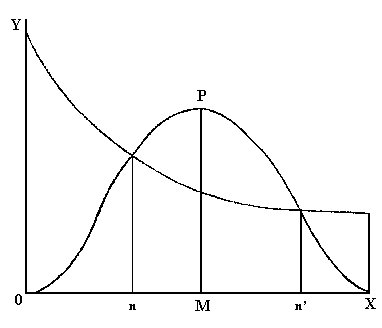
Lardner’s most important innovations must then seem to be, not his studies of cost behaviours on their own but in relating costs to revenues to formulate profit-maximising behaviour. These he summarised in a single diagram!(p.249)
Fig.III - Plotting Revenues (P) and Costs (Y) in relation to tariffs (O-X)
On the horizontal axis, Tariffs per mile were plotted, and vertically Gross receipts. Beyond tariff rates O-M, yielding receipts MP, we have declining demand and usage. Cheaper prices would produce a comparable fall in Gross receipts. For each class of traffic, the point at which maximum receipts are achieved should be found. But income and expense must be related.
The declining curve Y-q’’’ represents the total costs per unit; and break-even points are reached with tariffs equal to either n or n’. Maximum profits are not necessarily reached with maximum receipts but
"at the point at which the two curves become parallel to each other...To determine this point of maximum profits rigorously, it will be necessary to express the strict arithmetical relation between the tariff and the traffic. Now the relation will be different for every different railway and for every different class of traffic, and therefore admits of no general expression...In adjusting the tariff so as to correspond to it, the highest managerial skill will be shown" (p.252).
Lardner in following pages returned to formulae, hampered by his lack of differential calculus. For this he compensated by clear statements of the effects of cheaper carriage in reducing average total costs in the wider markets opened up - in the ratio of the square of the radial length of new railway track.
Some years after the publication of "Railway Economy", the UK Railway Companies Association (Regulation 1858, v.Hawke, p.321) resolved that rates and prices should be so fixed as to realise the largest amount of net profits, due regard being had to the interests of the public. But their near-monopoly power inhibited a rigorous exploitation of profit-maximisation, forcing them more often to aim at "fair remuneration".
The costing and controls of European railways must have been much influenced by an author from Britain, whence so many of the engineers had come. And German railway costs were subsequently studied by Garcke, the author with Fells of a well-known text on "Factory Accounts" (1887)
CONCLUSION
Because of parliamentary constraints and the intricacy of operations and services provided, because of the specialisation of engineering and economics, the railways did not contribute notably to costing theory or practice in other branches. The importance of railways in succession to canals and turnpike roads was clear to civil engineers, and to those planning and controlling capital works through parliamentary authorisation, share issues and the investment of the monies in permanent way, stations and rolling stock. While the "Double-account" system was developed and applied widely in UK railroads (cf Edwards, 1980, passim), Lardner concentrated on other aspects and cost comparabilities.
The influence of his economics study has been documented among later academics. Like some of his other works, "Railway Economics" had an encyclopaedic usefulness, and must have appealed to many professionals in the railway industry. Our interest has been on costs and pricing economics, where we found Lardner a fervent exponent of cost centres, cost allocation and absorption. But technical studies of cost-behaviours led him toward profit-maximisation and marginal pricing. These studies were thorough, well-informed and before their time. We have given largely personal reasons why he did not receive the serious attention in the industry which he deserved. We therefore have documented many grounds on which "Railway Economics" should be compared to other epic achievements of the railway age.
REFERENCES
Babbage, C. - The Economy of Manufactures (London, 1846)
Chandler, A.C. - The Visible Hand (Harvard, 1977)
Edwards, J.R. - British Company Legislation and Company Accounts, I & II(New York,1980)
Gras, N.S.B. - Business and Capitalism (New York,1939/1972)
Hawke, G.R. - "The Reputation of Dr.’Lardner" in "Railways and Economic Growth in England and Wales (Oxford, 1970)
Hoskin, K.W. & MacVe, R.H. - The Genesis of Accountability: The West Point Connection: A Paper presented to a British Accounting Assoc. Conference, Aberystwyth,1986
Hicks, J.R. - "Leo Walras" in Econometrica, 1934
Jevons, W.S. - Theory of Political Economy (1870; Pelican, 1970)
Kurpick, H. - "Fixe Kosten im Literatur bis zum 1900" : Schmalenbachs Zeitschrift fhF, 1963
Lardner, D. - "Railway Economy" (1850; reprinted David & Charles, 1963)
MacDermott, E.T. - History of the Great Western Railway (London, 1927)
Marshall, A. - Industry & Trade (London, 1919)
Marx, K. - Das Kapital, (1867)
Pollins, H. - "Aspects of Railway Accounting before 1868" in Studies in the History of Accounting ed. Yamey & Littleton, (London, 1958)
Rolt, L.T.C. - George and Robert Stephenson (London, 1960)
Young, G.M. - Victorian England (Oxford, 1939)
i Traffic and its costs in German literature is briefly treated in Forrester (1993, pp.253-255).
ii Unless otherwise stated, page references are to this work of 1850, reprinted 1963 by David and Charles.
iii Deloitte's activity for South American railroads is documented in that firm's history (p.19). Price, Waterhouse carried out audit work for US railroads which was "colossal" (Gras, p.212).
iv MacDermott (i, p.14) reports Brunel's temporary respect for Lardner who gained only an "ephemeral reputation".
v On this problem, see Pollins, 1958, pp.3243-49. Karl Marx in "Das Kapital",II,8,ii suggested that every capitalist needed a sinking fund for irregular replacements, the fund serving not as a hoard but through re-investment as capital for others.
vi Government intervention in British railways was coherently argued first by W. Galt in 1868 - cf Hawke, p.337
vii The decline in costs with distance carried was commonly exaggerated in Britain where identical tariffs were sometimes set to any market (Hawke, p.325)
viii Such precision found precedent in the calculations of road engineers like Telford adding the effects of wheel wear to the tear of horses' hooves: cf. Babbage's "Economy of Manufactures" (1846), p.246
ix This study was translated into German and published in Berlin, 1859: cf. Kurpick,1963. Note that Strousberg, the German railway magnate, attributed marginal pricing policies to British export-manufacturers: cf. his life publ.1876+