"Raising Minimum Wage Reduces Jobs, Poverty, Study Says Losses in
Employment Partly Offset by Increased Purchasing Power," by Eric Morath,
Damian Paletta and Carol E. Lee, The Wall Street Journal, February
18, 2014 ---
http://online.wsj.com/news/articles/SB10001424052702304675504579391201355442502?mod=djemCFO_h
President Barack Obama's quest to raise the federal minimum wage to $10.10 an hour would eliminate about 500,000 jobs by 2016 but increase pay for millions of Americans and lift nearly a million out of poverty, a Congressional Budget Office report found.
The estimates released Tuesday by the nonpartisan budget office add fuel to the debate among economists and politicians about the impact of raising the minimum wage from the current $7.25 an hour.
The report nodded to economic arguments made by liberals and conservatives, predicting 16.5 million workers would benefit from an increase in the minimum wage, but also estimating that the job losses could hit a minority of workers.
Republicans pointed to the report's predicted job losses as proof that raising the minimum wage would damage the economy. The White House, which has pitched a higher minimum wage as a top priority this year, disputed that conclusion and said an increase would help workers and spur economic growth.
The CBO said that a gradual increase to $10.10 an hour by July 2016 would eliminate 500,000 jobs, but lift 900,000 Americans out of poverty from the total of 45 million projected to be living in poverty in 2016.
The poverty estimate took into account both families whose incomes would rise enough to lift them out of poverty, and families whose income would fall enough to move them into poverty.
The benefits of an increase would be spread across a broad swath of workers, the CBO said, with 19% of the increased wages going to Americans living below the poverty line. Close to 30% of the higher wages would go to people in families that earned more than three times the poverty level, as many minimum-wage workers are second earners and teenagers living in middle- or upper-income households.
The boost would raise earnings of low-wage workers by $31 billion, the CBO said, but it would also reduce or eliminate the wages of Americans who lost their job because of the increase. On net, the wage increase would raise "overall real income" by $2 billion, the CBO said.
Roughly 3.6 million Americans were paid $7.25 an hour or less in 2012, according to the Labor Department, representing 4.7% of hourly workers. Women are twice as likely as men to earn the minimum wage, according to government data. Roughly half of workers earning at or less than the minimum wage were between the ages of 16 and 24.
Jason Furman, chairman of the White House Council of Economic Advisers, told reporters that the study "very much does make the case for a policy that benefits more than 16.5 million workers."
Some big trade groups criticized Mr. Obama's push. The National Restaurant Association said the CBO report provided "further evidence that an increase in the minimum wage…would significantly limit the entry-level opportunities businesses can provide, hurting employees with limited skills or experience and looking to enter the workforce."
Some business owners say they favor a wage increase. David Bolotsky, chief executive at Uncommon Goods, a Brooklyn, N.Y., online retailer, said boosting the minimum wage would give consumers more money to spend. He backs a proposal advanced by Democrats in Congress that ties future increases to inflation. "That gives me certainty, and that's most important when running a business," he said.
The U.S. government has had a minimum wage since 1938, and it has been raised close to 30 times, but when adjusted for inflation, it peaked in 1968. It was last raised in 2009 as part of a three-phase increase. Close to 20 states require that employers pay a higher minimum wage than the federal level. The majority of people who earn the minimum wage work in jobs like food preparation and other service-related fields.
Mr. Obama, who called on Congress to pass an increase in the minimum wage in his State of the Union address last month, recently signed an executive order raising the wage for workers on new federal contracts. The move was part of an effort to pressure congressional Republicans to pass a broader increase.
A signature part of the president's argument in favor of an increase, which Republicans oppose, has been that it would not adversely affect job growth. White House press secretary Jay Carney argued Tuesday that there was no evidence that raising the minimum wage "has a significant impact on jobs."
The report could blunt the political momentum Democrats had hoped the issue would give them in November's midterm elections—and in the presidential election in 2016, the year the CBO focused on. Democrats have highlighted the issue as a way to draw a contrast with Republicans.
Senate Minority Leader Mitch McConnell (R., Ky.) said the GOP was eager to have the debate, arguing that the report shows a minimum-wage rise "could destroy as many as one million jobs, a devastating blow to the very people that need help most in this economy."
Other Republicans echoed that sentiment. "This report confirms what we've long known: While helping some, mandating higher wages has real costs, including fewer people working. With unemployment Americans' top concern, our focus should be creating—not destroying—jobs for those who need them most," said Brendan Buck, a spokesman for House Speaker John Boehner (R., Ohio), in a statement.
Richard Trumka, president of union federation AFL-CIO, which is holding its winter meeting of labor leaders in Houston this week to strategize for the year, immediately challenged the study's findings and said it echoed false claims by conservatives. "Every time momentum builds for lifting wages, conservative ideologues say it will cost jobs. Every time, they've been dead wrong," Mr. Trumka said in an emailed statement issued during his closed-door meeting with labor leaders.
Senate Democrats have signaled they will hold a vote to raise the minimum wage soon, but Mr. Boehner has said he opposes an increase. Democrats in a number of states, including Maryland and Massachusetts, are planning to push for their own increases this year, and the CBO report could fuel supporters and opponents during local debates.
The CBO report said that the increased cost of labor would encourage employers to upgrade technology or hire fewer, higher-skilled workers. That effect would be partially offset by higher earnings among low-wage workers who retained their jobs.
That prediction could well play out at Bacci Chocolate Design, a small candy maker in Swampscott, Mass., which typically hires high-school students to lend a hand during the firm's busy season. The minimum wage in Massachusetts is $8 an hour.
Continued in article
Jensen Comment
Much depends on how we define "job losses." If a job is eliminated it counts
as a job loss. If workers accustomed to 40 hours per week are cut back to 25
hours per week it's not a job loss but an earnings loss. Raising the minimum
wage from to $10.10 in 2014 is poorly timed with the Affordable
Healthcare Act's definition of a part-time job (not requiring
employer-provided health insurance) as less than 30 hours per week. Both
forces will eliminate a lot more hours of work than hours lost due to
complete elimination of jobs.
With the elimination of jobs following the 2007 recession and robotics, many minimum-wage jobs that were for transitional employment increasingly became filled by longer-term workers. For example, for example students often worked summers and even while going to school at minimum wage as food servers. They had no intent if making a career for the remainder of their lives as food servers. Now mom and grandma are competing with their children for the same jobs because mom and grandma cannot find higher paying employment.
Raising the minimum wage is fair for those like mom and grandma intending to make this wage for the remainder of their careers. It is not fair if students, especially teens, can no longer find work due business firms and government no longer being able to provide as many jobs at higher minimum wages. The rise in the minimum wage should be tied to provisions to provide teens and college students opportunities to work and/or intern for less than minimum wage.
Also worrisome is the loss of competition. For example, Starbucks fully supports raising the minimum wage. In part this is because many competing mom and pop coffee shops operating on the margin will be driven out of business by higher minimum wages. Starbucks will then be the only coffee shop around unless there happens to be a nearby Dunkin' Donuts. That is often not the case, especially in troubled malls where 90% of the food court providers have disappeared.
Question
What happens when your network coverage does not extend to where you travel
or live part of the year in the USA?
"ObamaCare Found To Restrict Where You Live And Travel,"
Investors.com, December 18, 2013 ---
http://news.investors.com/ibd-editorials-obama-care/121813-683475-obamacare-interferes-with-residential-and-travel-liberties.htm#ixzz2nt5oKeR8
. . .
But Americans are now about to find themselves grappling with their own bureaucratic Berlin Wall. The American Thinker's Stella Paul has exposed the virtually unnoticed fact that within the ObamaCare exchanges so many Americans are being forced into, "most plans only provide local medical coverage."
Paul warns this will have "a profound impact on the real-estate market, particularly the second home sector, and on the travel business." She interviewed one Connecticut retiree whose health required having a winter home in South Carolina. Her $450-per-month, $2,500 deductible, no co-pay Blue Cross policy that had worked well in both states was suddenly canceled.
The new policy she was offered under ObamaCare was twice as expensive, with a deductible costing $1,000 more, and no out-of-network coverage.
Having had a surgery at Memorial Sloan-Kettering Cancer Center in New York City, out-of-network coverage was a must. And she found it. "It's $900 a month," she told Paul, "with a $7,000 deductible and a co-pay on everything. Basically, it's catastrophic insurance, and I'll be paying my South Carolina doctors out of pocket."
A prominent New York insurance broker pointed out that most of the policies offered on the ObamaCare exchanges are not national networks, so "if you need routine medical services, they will not be covered when you leave your local area," as they were before.
Travel health insurance, unfortunately, only covers emergencies. So, the broker told Paul, "a large portion of the population will have their insurance as a consideration for their mobility, which they never had before."
Imagine having to take all this into account in making decisions about where in America you want to live.
And as Paul asks, "With Americans no longer able to receive routine medical services when they travel, will they start showing up in emergency rooms for sore throats and backaches? And how will these new throngs of patients affect the waiting time of people with genuine medical emergencies?"
Meet the latest unpleasant ObamaCare surprise, right on the heels of HHS Secretary Kathleen Sebelius this week finally admitting that, contrary to Obama's endlessly repeated promise, "there are some individuals who may be looking at increases" in premiums.
Unrestricted movement is a birthright of our liberty. Even socialized medicine's harshest opponents didn't suspect Washington would trample that freedom.
Read More At Investor's Business Daily:
http://news.investors.com/ibd-editorials-obama-care/121813-683475-obamacare-interferes-with-residential-and-travel-liberties.htm#ixzz2nwmccDvD
Obamacare: Limits Placed Upon Choosing Your Own Doctor and Hospital
Jensen Comment
The media along with President Obama led us to believe that medical insurance
plans were going to vary only be the amount of the deductibles and age of the
applicant. We are now learning more about differences in medical networks of
hospitals and doctors. The President kept insisting that we could keep our
present doctors. Technically that was not a lie, but what was left unsaid is
that to literally keep your favored doctors and hospitals you may have to opt
for the more expensive Cadillac plans having "broader network coverage "of
physicians and selective hospitals that opted out of serving the lower-priced
limited network plans.
Dr. Ezekiel Emanuel --- http://en.wikipedia.org/wiki/Ezekiel_Emanuel
"ObamaCare in Translation Ezekial Emanuel explains what the President really
meant about your doctor," The Wall Street Journal, December 8, 2013 ---
http://online.wsj.com/news/articles/SB10001424052702304014504579246552456954872?mod=djemEditorialPage_h
. . .
Mr. Wallace: "It's a simple yes or no question. Didn't he say if you like your doctor, you can keep your doctor?"
Dr. Emanuel: "Yes. But look, if you want to pay more for an insurance company that covers your doctor, you can do that. This is a matter of choice. We know in all sorts of places you pay more for certain—for a wider range of choices or wider range of benefits. The issue isn't the selective networks. People keep saying, 'Oh, the problem is you're going to have a selective network.'"
Mr. Wallace: "Well, if you lose your doctor or lose your hospital—"
Dr. Emanuel: "Let me just say something. People are going to have a choice as to whether they want to pay a certain amount for a selective network or pay more for a broader network."
Mr. Wallace: "Which means your premiums would probably go up."
Dr. Emanuel: "They get that choice. That's a choice you've always made."
It's nice to hear a central planner embrace choice, except this needs translating too. The truth is that you may be able to pay more to keep your doctor, but only after you choose one of ObamaCare's preferred plans that already costs you more than your old plan that ObamaCare forced you to give up.
Jensen Comment
What Dr. Emanuel failed to mention is that the "broader expensive network" plans
are Cadillac plans for which employers lose their tax deductions.
The Cadillac Tax: A Game Changer for U.S. Health Care: Can you
explain this tax to your students?
Do you understand the Cadillac Tax provision of the Affordable Healthcare Act
that will have a monumental 2018 impact on healthcare coverage of employees who
are now covered by employer plans --- plans now costing the government over $250
billion per year? But not for long!
Do you understand the Cadillac Tax provision?
Me neither. As Nancy Pelosi said years ago, Congress passed the ACA before
anybody in the USA had a chance to study all the surprises in this the enormous
bill.
If you're covered presently on your employer's plan you should most certainly learn about the Cadillac Tax provision that kicks in in 2018.
"The Cadillac Tax: A Game Changer for U.S. Health Care." by Jonathan
Gruber (MIT), Harvard Business Review Blog, November 15. 2013 ---
http://blogs.hbr.org/2013/11/the-cadillac-tax-a-game-changer-for-u-s-health-care/
Jensen Comment
Non-profit organizations, especially labor unions, for whom Cadillac plans are
especially popular will be allowed to keep their plans without penalty since tax
deductions are not of concern to them.
Having preferred networks of doctors and hospitals is not unheard of in national health care plans. Germany, for example, has both public health insurance plus premium coverage with private insurance. Cuba notoriously has bourgeoisie plans for members of the Communist Party and the wealthy versus proletariat plans for the poor people.
If you Congressional representative brags about signing up for Obamacare ask if he or she has a Cadillac Obamacare plan that lets them choose their own doctors and hospitals.
Congress Has a Cadillac Plan for a Lifetime of Coverage
"Harry Reid Takes Taxpayer Subsidy: 'My Employer Helps Me Pay for My
Health Care'," CNS News, December 18, 2013 ---
http://cnsnews.com/news/article/penny-starr/harry-reid-takes-taxpayer-subsidy-my-employer-helps-me-pay-my-health-care
Senate Majority Leader Harry Reid (D.-Nev.), whose salary is $193,400 a year, said he has purchased a health care plan through the D.C. Obamacare exchange and that he is accepting the federal subsidy that can run up up to $11,378 per year for a member of Congress to purchase a plan on that exchange.“I’m just like 150 million other people in America,” Reid said. “My employer helps me pay for my health care.”
- See more at: http://cnsnews.com/news/article/penny-starr/harry-reid-takes-taxpayer-subsidy-my-employer-helps-me-pay-my-health-care#sthash.G5apDcuR.dpufSenate Majority Leader Harry Reid (D.-Nev.), whose salary is $193,400 a year, said he has purchased a health care plan through the D.C. Obamacare exchange and that he is accepting the federal subsidy that can run up up to $11,378 per year for a member of Congress to purchase a plan on that exchange.“I’m just like 150 million other people in America,” Reid said. “My employer helps me pay for my health care.”
- See more at: http://cnsnews.com/news/article/penny-starr/harry-reid-takes-taxpayer-subsidy-my-employer-helps-me-pay-my-health-care#sthash.G5apDcuR.dpufSenate Majority Leader Harry Reid (D.-Nev.), whose salary is $193,400 a year, said he has purchased a health care plan through the D.C. Obamacare exchange and that he is accepting the federal subsidy that can run up up to $11,378 per year for a member of Congress to purchase a plan on that exchange.
“I’m just like 150 million other people in America,” Reid said. “My employer helps me pay for my health care.”
Continued in article
"Obamacare: Silence of the Insurers," by Jonah Goldberg, Townhall,
December 18, 2013 ---
http://townhall.com/columnists/jonahgoldberg/2013/12/18/obamacare-silence-of-the-insurers-n1764535?utm_source=thdaily&utm_medium=email&utm_campaign=nl
When will the insurers revolt?
It's a question that's popping up more and more. On the surface, the question answers itself. We're talking about pinstriped insurance company executives, not Hells Angels. One doesn't want to paint with too broad a brush, but if you were going to guess which vocations lend themselves least to revolutionary zeal, actuaries rank slightly behind embalmers.
Still, it's hard not to wonder how much more these people are willing to take. Even an obedient dog will bite if you kick it enough. Since Obamacare's passage, the administration has constantly moved the goalposts on the industry. For instance, when the small-business mandate proved problematic in an election year, the administration delayed it, putting its partisan political needs ahead of its own policy and the needs of the industry.
But the insurers kept their eyes on the prize: huge guaranteed profits stemming from the diktat of the health insurance mandate. When asked how he silenced opponents in the health industry during his successful effort to socialize medicine, Aneurin Bevan, creator of the British National Health Service, responded, "I stuffed their mouths with gold."
Hence, the insurers were ready on Oct. 1. They rejiggered their industry. They sent out millions of cancellation letters to customers whose plans no longer qualified under the new standards set by the Affordable Care Act. They told their customers to go to the exchanges to get their new plans.
But because President Obama promised Americans "if you like your health care plan, you can keep it," (PolitiFact's "Lie of the Year"), those cancellations became a political problem of Obama's own making.
In response, the president blamed it on the insurance companies or "bad apple" insurers. White House spokesman Jay Carney insisted that it was the insurance companies that unilaterally decided not to grandfather existing plans. (The Washington Post's "Fact Checker" columnist, Glenn Kessler, gave this claim "Three Pinocchios.")
Then, just last week, Health and Human Services Secretary Kathleen Sebelius announced that she was "urging" insurers to ignore both their contracts and the law and simply cover people on the honor system -- as if they were enrolled and paid up. She also wants doctors and hospitals to take patients, regardless of whether they are in a patients' insurance network or even if the patient is properly insured at all. Just go ahead and extend the deadline for paying, she urged insurers; we'll work out the paperwork later.
Of course, urging isn't forcing. But as Avik Roy of Forbes notes, the difference is subtle. Also last week, HHS also announced last week that it will consider compliance with its suggestions when determining which plans to allow on the exchanges next year. A request from HHS is like being asked a "favor" by the Godfather; compliance is less than voluntary.
The irony, as Christopher DeMuth recently noted in the Weekly Standard, is that if the architects of Obamacare had their way, the insurers would have been in even worse shape today. The original plan was for a "public option" that would have, over time, undercut the private insurance market to the point where single-payer seemed like the only rational way to go. If it weren't for then-Sen. Joe Lieberman's insistence that the provision be scrapped, DeMuth writes, "Obamacare's troubles would today be leading smoothly to the expansion of direct federal health insurance to pick up millions of canceled policies and undercut rate increases on terms no private firm could match."
In other words, the insurers knew the administration never had their best interests at heart but got in bed with it anyway.
Continued in article
Jensen Comment
Until recently the enthusiasm of medical insurance companies was
understandable since the the losses for deductible portions of contracts
were passed on mostly to patients themselves and possibly their doctors.
Most medical service bad debts of for default of premium payments were
passed on to hospitals and doctors.
Also the big and prosperous insurance companies were allowed to opt out of participating in the more risky health insurance exchanges. Most did opt out such that the government had to make loans for new exchange companies to to become insurers for individuals not covered by their employers. These exchanges are poorly capitalized, and many will probably have to be bailed out by the government if and when they encounter insolvency.
To get more heavily capitalized insurance companies to participate would require higher premium rates and more protection against bad debt losses. But this in turn would raise premiums dramatically and be counter to the whole purpose of Obamacare --- to get more people insured and using more preventative care options. High premiums and low deductibles could destroy Obamacare by making more rather than fewer people insured.
The silence of the media on astute health care providers is more
problematic.
Many of the biggest and best hospitals like the Andersen Cancer Center will
not serve patients covered by the exchanges. Over 70% of California's
physicians will not serve patients covered by the exchanges (except in the
case where emergency treatment is called for).
Has any media source complained that with proper investment planning very wealthy people, especially college students on trust funds, may get free Medicaid medical care and medications.
Jensen Question
I asked the following question on the Turbo Tax Forum Regarding Obamacare Questions:
Question
I'm told that only income, not wealth, will be the deciding factor on eligibility for Medicaid beginning in 2014.
If I'm a full time student having zero income and $10 million trust fund of stock paying no dividends, will I be eligible for Medicaid?A Turbo Tax expert says that wealth may still be a criterion in the states that rejected the Medicaid expansion. Having valuable assets is no longer a criterion in those states that yielded to Whitehouse pressure and temporary funding to expand Medicaid roles.
I am honestly confused by the assertion that your wealth after 2014 will not affect your eligibility for Medicaid. In does not seem right that students on trust funds should be getting free medical care and medications.
"Obama's Mental Health Solution Falls Flat," by Nicole Bailey,
Townhall, December 2, 2013 ---
http://townhall.com/tipsheet/nicolebailey/2013/12/12/obamas-mental-health-solution-falls-flat-n1761910?utm_source=thdailypm&utm_medium=email&utm_campaign=nl_pm
. . .
The Obama administration has expanded mental health care coverage, but the latest research shows that psychiatrists often do not accept insurance at all. When only 43% of psychiatrists accept Medicaid, it is difficult to see how expanded coverage will help mental health patients.
Psychiatrists accept medical insurance less frequently than other specialists across the board, according to the study published in JAMA Psychiatry by researchers from three separate medical schools:
- 55.3% of psychiatrists accepted medical insurance in general, compared to 88.7% of other physicians
- 54.8% of psychiatrists accepted Medicare, compared to 86.1% of other physicians
- 43.1% of psychiatrists accepted Medicaid, compared to 73.0% of other physicians
The mainline media seems to avoid the greatest concerns of Obamacare --- concerns about making hospitals and doctors absorb most of the costs of medical care during the 90-day premium default grace period and the cost of serving patients who afterwards renege on paying the deductible portions that they agreed to pay to get lower premium plans.
The USA now has a dual health care program --- the highest quality health care in the world for the wealthy on Cadillac medical insurance plans and inferior quality health care in the chaos of Obamacare that will force soaring inflation in health care provider pricings. Your local Congressional representative is signing up for a Cadillac plan paid for by taxpayers.
Bob Jensen's universal health care messaging --- http://www.trinity.edu/rjensen/Health.htm
Approximately 7 out of every 10 doctors in California have said they will not participate in California’s Obamacare health insurance exchange, according to the Washington Examiner and several other media sources on Friday.
"70% of California doctors are boycotting California's Obamacare
exchanges," Washington Examiner, December 7, 2013 ---
http://www.examiner.com/article/70-of-california-doctors-are-boycotting-california-s-obamacare-exchanges
An estimated seven out of every 10 physicians in deep-blue California are rebelling against the state's Obamacare health insurance exchange and won't participate, the head of the state's largest medical association said.
“It doesn't surprise me that there's a high rate of nonparticipation,” said Dr. Richard Thorp, president of the California Medical Association.
horp has been a primary care doctor for 38 years in a small town 90 miles north of Sacramento. The CMA represents 38,000 of the roughly 104,000 doctors in California.
“We need some recognition that we’re doing a service to the community. But we can’t do it for free. And we can’t do it at a loss. No other business would do that,” he said.
California offers one of the lowest government reimbursement rates in the country -- 30 percent lower than federal Medicare payments. And reimbursement rates for some procedures are even lower.
In other states, Medicare pays doctors $76 for return-office visits. But in California, Medi-Cal's reimbursement is $24, according to Dr. Theodore M. Mazer, a San Diego ear, nose and throat doctor.
In other states, doctors receive between $500 to $700 to perform a tonsillectomy. In California, they get $160, Mazer added.
Only in September did insurance companies disclose that their rates would be pegged to California’s Medicaid plan, called Medi-Cal. That's driven many doctors to just say no.
They're also pointing out that Covered California's website lists many doctors as participants when they aren't.
“Some physicians have been put in the network and they were included basically without their permission,” Lisa Folberg said. She is a CMA’s vice president of medical and regulatory Policy.
“They may be listed as actually participating, but not of their own volition,” said Donald Waters, executive director of the Alameda-Contra Costa Medical Association.
Waters' group represents 3,100 doctors in the East Bay area that includes Oakland, with an estimated 200,000 uninsured individuals.
“This is a dirty little secret that is not really talked about as they promote Covered California,” Waters said. He called the exchange's doctors list a “shell game” because “the vast majority” of his doctors are not participating.
Independent insurance brokers who work with both insurance companies and doctor networks estimate that about 70 percent of California's 104,000 licensed doctors are boycotting the exchange.
Continued in article
Jensen Comment
Five guesses as to what will happen to insurance premiums when millions of
people at last are signed up for insurance from the exchanges?
Hint
The answer is not one thing.
- First will be the raising of premiums to cover added payments to
doctors.
- Second will be the raising of premiums to cover the bad debts of
hospitals and doctors for the high deductibles and higher preiums that
millions of newly insured people will be unable to pay when they are
seriously ill.
- Third will be the long delays to make appointments with doctors who
are participating in the exchange programs. Experience with
Romneycare in in Massachusetts found that appointment delays went up an
average of six weeks.
- Fourth will be the toughing out of individuals who will not seek
medical care because of the cost of the deductibles.
- Fifty will be the increased lines in emergency rooms for people to ill or injured to wait a month or two to see a doctor.
Jensen Comment
Until now the media has has avoided mentioning the really big worries about
Obamacare in an effort to present a rosy picture to encourage millions of
people to sign up. What goes unmentioned, until the December 8, 2013 article
in the WSJ quoted below, is that hospital bad debts with greatly increase
due to people patients being unable to pay their deductibles.
December 6, 2013 message from Bob Jensen
Hi Zafar,
A major portion of the medical cost for the "uninsured" currently gets passed on to taxpayers since people that have no insurance are passed on to hospitals that are subsidized by taxpayers to cover the uninsured such as in San Antonio where most uninsured patients are passed on to the huge Bexar County Hospital that is heavily funded by county property taxes. The Bexar County Hospital portion of my property tax bill exceeded $1,000 per year when I lived in San Antonio.
Of course since that $1,000 gave me about a $400 tax break on my Federal income tax return, the Federal Government was in essence paying for 40% of my share of paying for the uninsured served at the Bexar County Hospital.
The bad debt losses that currently hit hospitals not subsidized by property taxpayers are for "insured" patients who do not have sufficient coverage to pay entire billings beyond what their insurance will pay. The new exchange insurance plans with enormous deductibles such as the Bronz plans that only pay 60% will greatly increase the losses to hospitals for "insured" patients who cannot pay their 40% share of the hospital and physician billings..
My point is that a huge portion of medical care costs that are now paid by property taxpayers for "uninsured" patients will no longer be paid by taxpayers because those patients are now "insured" with low premium, high-deductible plans where many of those patients cannot afford the deductibles for hospital bills. Taxpayers in San Antonio with high property taxes may cheer the savings that must in the future be choked on by the hospitals that are not property tax funded.
In other words, somebody pays for hospital patients' bad debts. The "uninsured" are now heavily subsidized by county and city property taxpayers. Giving the uninsured insurance with low premiums and high deductibles is really a transfer payment from property taxpayers to whomever will pay for the added bad debts of defaulted deductibles.
I don't think this system is sustainable until there is USA National Health Program.
Respectfully,Bob Jensen
The American Hospital Association, which represents for-profit and nonprofit hospitals and other health-care providers, concurred that the higher deductibles "will likely lead to an increase in hospital bad debt," said Ashley Thompson, its deputy director for policy.
"High Deductibles Fuel New
Worries of Health-Law Sticker Shock Some Lower-Cost Plans Carry Steep
Deductibles, Posing Financial Challenge," by By Leslie Scism and Timothy
W. Martin, The Wall Street Journal, December 8,
2013 ---
http://online.wsj.com/news/articles/SB10001424052702303330204579246211560398876?mod=ITP_pageone_0
. . .
The health law makes tax credits available to help cover insurance premiums for people with annual income up to four times the poverty level, or $45,960 for an individual. In addition, "cost-sharing" subsidies to help pay deductibles are available to people who earn up to 2.5 times the poverty level, or about $28,725 for an individual, in the exchange's silver policies.
As enrollment picks up on HealthCare.gov, many people with modest incomes are encountering a troubling element: deductibles so steep they may not be able to afford the portion of medical expenses that insurance doesn't cover. Christopher Weaver discusses. Photo: Getty Images.
But those limits will leave hundreds of thousands or more people with a difficult trade-off: They can pay significantly higher premiums for the exchange's silver, gold and platinum policies, which have lower deductibles, or gamble they won't need much health care and choose a cheaper bronze plan. Moreover, the cost-sharing subsidies for deductibles don't apply to the bronze policies.
That means some sick or injured people may avoid treatment so they don't rack up high bills their insurance won't cover, according to consumer activists, insurance brokers and public-policy analysts—subverting one of the health law's goals, which is to ensure more people receive needed health care. Hospitals, meantime, are bracing for a rise in unpaid bills from bronze-plan policyholders, said industry officials and public-policy analysts.
Because all health plans now are required to provide certain minimum benefits, "consumers may be tempted to shop on premium alone, not realizing that the out-of-pocket costs can have a dramatic effect upon the annual costs of health care," said Kevin Coleman, head of research and data at HealthPocket.
Mr. Coleman said he expects the high deductibles will "produce some reduction in medical-service use" for enrollees who don't qualify for subsidies.
. . .
The American Hospital Association, which represents for-profit and nonprofit hospitals and other health-care providers, concurred that the higher deductibles "will likely lead to an increase in hospital bad debt," said Ashley Thompson, its deputy director for policy.
It isn't known how many bronze policies have been bought so far because the exchanges aren't releasing that level of detail, HealthPocket's Mr. Coleman said.
December 6, 2013 message from Bob Jensen
Hi Eliot,
When there's no Obamacare there will be a USA National Health Plan that bypasses medical insurance companies. It's possible that we will still have such companies offering private insurance beyond what the USA National Plan covers. This "dual coverage" is how the German health insurance system now works. According to various sources in Germany at the moment (mostly Erika's relatives), the time and a6ttention and service varies in ways that that you might find objectionable. The best doctors give more attention and faster service to German patients with private insurance. For example, waiting for new knees can take much longer without private insurance.
Health Insurance in Germany --- http://www.toytowngermany.com/wiki/Health_insurance
Our present USA Medicare system works on a dual basis. Erika and I pay nearly $200 per month (each) for supplemental p private Medicare insurance that eliminates the Medicare deductibles (co-insurance) and does such things as pay for the added cost of private hospital rooms. Of course Medicare costs us hundreds more each month such that the supposedly "free" Medicare costs us each nearly $400 per month. Erika pays all our bills such that I don't know the exact amounts. She allows me to carry one check if I promise not to use it.
Thus far I've fortunately paid much more into the Medicare system since my 2006 retirement than I've withdrawn. Erika sadly has withdrawn over $1 million from the system.
We've gone beyond the point of no return for Obamacare, although I think the Obamacare is so complicated and unjust that it will evolve into a national health care plan perhaps something like that in Germany. The Canada system is not a very good model, because it varies between provinces and has long delays for elective procedures such as new knees and hips. Canada has a dual system where the poor wait and the rich come to the USA for faster service.
Personally I think the evolution of Obamacare into a USA National Health Plan will be inevitable.
Obamacare is a disaster in terms of the size of the deductibles for plans that are affordable. Obamacare is a disaster in terms of the cheating that will become commonplace for the subsidies. Obamacare will be a disaster for insurance companies and health providers who will have to absorb enormous losses such as bad debt losses. Obamacare is a disaster in that we probably won't even note a significant difference in the crowds lining up in emergency rooms seeking free diagnostics, treatments, and drugs.
There will be frustrating years of turmoil in the USA health system until a USA National Health Plan finally evolves.
Respectfully,
Bob Jensen
I might note that the premium subsidies paid my Uncle Sam are a new thing and will probably become a larger scam than anything we've known in healthcare fraud prior to 2014. But let's ignore the new scam in town and the IRS refusal to enforce the subsidy rules.
Of course the hospitals and physicians will send in the debt collection agencies. But the millions of plans that were wiped out of the system in 2013 had much lower deductibles and often higher premiums. The premiums beginning in 2014 are cheaper in many instances because the deductible amounts were greatly increased such as the new Bronz plans where insurance companies only pay 60%.
Nobody seems to be talking about it, but when those big hospital bills hit the fan the people opting for the lowest premiums (and high deductibles) are the people least able to pay the deductibles for huge medical bills.
Yes I do think the problem of bad debts for huge deductibles will be a bigger, and bigger problem beginning in 2014 because the options for plans with enormous deductibles have been increased so greatly beginning in 2014.
What was a huge bad debt problem for hospitals and physicians in 2013 will become a monster bad debt problem after 2013. The problem is not so much with the premium amounts as it is the deductible amounts.
But don't look for the media to even whisper the future bad debt monster for medical providers.
Respectfully,
Bob Jensen
Jensen Comment
Until now the media has has avoided mentioning the really big worries about Obamacare in an effort to present a rosy picture to encourage millups upon millions of people to sign up. What goes unmentioned, until today's article in the WSJ quoted below, is that hospital bad debts with greatly increase due to people patients being unable to pay their deductibles.December 6, 2013 message from Bob Jensen
Hi Zafar,
A major portion of the medical cost for the "uninsured" currently gets passed on to taxpayers since people that have no insurance are passed on to hospitals that are subsidized by taxpayers to cover the uninsured such as in San Antonio where most uninsured patients are passed on to the huge Bexar County Hospital that is heavily funded by county property taxes. The Bexar County Hospital portion of my property tax bill exceeded $1,000 per year when I lived in San Antonio.
Of course since that $1,000 gave me about a $400 tax break on my Federal income tax return, the Federal Government was in essence paying for 40% of my share of paying for the uninsured served at the Bexar County Hospital.
The bad debt losses that currently hit hospitals not subsidized by property taxpayers are for "insured" patients who do not have sufficient coverage to pay entire billings beyond what their insurance will pay. The new exchange insurance plans with enormous deductibles such as the Bronz plans that only pay 60% will greatly increase the losses to hospitals for "insured" patients who cannot pay their 40% share of the hospital and physician billings..
My point is that a huge portion of medical care costs that are now paid by property taxpayers for "uninsured" patients will no longer be paid by taxpayers because those patients are now "insured" with low premium, high-deductible plans where many of those patients cannot afford the deductibles for hospital bills. Taxpayers in San Antonio with high property taxes may cheer the savings that must in the future be choked on by the hospitals that are not property tax funded.
In other words, somebody pays for hospital patients' bad debts. The "uninsured" are now heavily subsidized by county and city property taxpayers. Giving the uninsured insurance with low premiums and high deductibles is really a transfer payment from property taxpayers to whomever will pay for the added bad debts of defaulted deductibles.
I don't think this system is sustainable until there is USA National Health Program.
Respectfully,Bob Jensen
Bob Jensen's universal health care messaging --- http://www.trinity.edu/rjensen/Health.htm
Obamacare: Limits Placed Upon Choosing Your Own Doctor and Hospital
Jensen Comment
The media along with President Obama led us to believe that medical
insurance plans were going to vary only be the amount of the deductibles and
age of the applicant. We are now learning more about differences in medical
networks of hospitals and doctors. The President kept insisting that we
could keep our present doctors. Technically that was not a lie, but what was
left unsaid is that to literally keep your favored doctors and hospitals you
may have to opt for the more expensive Cadillac plans having "broader
network coverage "of physicians and selective hospitals that opted out of
serving the lower-priced limited network plans.
Dr. Ezekiel Emanuel --- http://en.wikipedia.org/wiki/Ezekiel_Emanuel
"ObamaCare in Translation Ezekial Emanuel explains what the President
really meant about your doctor," The Wall Street Journal, December 8,
2013 ---
http://online.wsj.com/news/articles/SB10001424052702304014504579246552456954872?mod=djemEditorialPage_h
. . .
Mr. Wallace: "It's a simple yes or no question. Didn't he say if you like your doctor, you can keep your doctor?"
Dr. Emanuel: "Yes. But look, if you want to pay more for an insurance company that covers your doctor, you can do that. This is a matter of choice. We know in all sorts of places you pay more for certain—for a wider range of choices or wider range of benefits. The issue isn't the selective networks. People keep saying, 'Oh, the problem is you're going to have a selective network.'"
Mr. Wallace: "Well, if you lose your doctor or lose your hospital—"
Dr. Emanuel: "Let me just say something. People are going to have a choice as to whether they want to pay a certain amount for a selective network or pay more for a broader network."
Mr. Wallace: "Which means your premiums would probably go up."
Dr. Emanuel: "They get that choice. That's a choice you've always made."
It's nice to hear a central planner embrace choice, except this needs translating too. The truth is that you may be able to pay more to keep your doctor, but only after you choose one of ObamaCare's preferred plans that already costs you more than your old plan that ObamaCare forced you to give up.
Jensen Comment
What Dr. Emanuel failed to mention is that the "broader expensive network"
plans are Cadillac plans for which employers lose their tax deductions.
The Cadillac Tax: A Game Changer for U.S. Health Care: Can you
explain this tax to your students?
Do you understand the Cadillac Tax provision of the Affordable Healthcare Act
that will have a monumental 2018 impact on healthcare coverage of employees who
are now covered by employer plans --- plans now costing the government over $250
billion per year? But not for long!
Do you understand the Cadillac Tax provision?
Me neither. As Nancy Pelosi said years ago, Congress passed the ACA before
anybody in the USA had a chance to study all the surprises in this the enormous
bill.
If you're covered presently on your employer's plan you should most certainly learn about the Cadillac Tax provision that kicks in in 2018.
"The Cadillac Tax: A Game Changer for U.S. Health Care." by Jonathan
Gruber (MIT), Harvard Business Review Blog, November 15. 2013 ---
http://blogs.hbr.org/2013/11/the-cadillac-tax-a-game-changer-for-u-s-health-care/
Jensen Comment
Non-profit organizations, especially labor unions, for whom Cadillac plans
are especially popular will be allowed to keep their plans without penalty
since tax deductions are not of concern to them.
Having preferred networks of doctors and hospitals is not unheard of in national health care plans. Germany, for example, has both public health insurance plus premium coverage with private insurance. Cuba notoriously has bourgeoisie plans for members of the Communist Party and the wealthy versus proletariat plans for the poor people.
If your Congressional representative brags about signing up for Obamacare ask if he or she has a Cadillac Obamacare plan that lets them choose their own doctors and hospitals.
Bob Jensen's universal health care messaging --- http://www.trinity.edu/rjensen/Health.htm
December 6, 2013 message from Bob Jensen
Hi Eliot,
When there's no Obamacare there will be a USA National Health Plan that bypasses medical insurance companies. It's possible that we will still have such companies offering private insurance beyond what the USA National Plan covers. This "dual coverage" is how the German health insurance system now works. According to various sources in Germany at the moment (mostly Erika's relatives), the time and a6ttention and service varies in ways that that you might find objectionable. The best doctors give more attention and faster service to German patients with private insurance. For example, waiting for new knees can take much longer without private insurance.
Health Insurance in Germany --- http://www.toytowngermany.com/wiki/Health_insurance
Our present USA Medicare system works on a dual basis. Erika and I pay nearly $200 per month (each) for supplemental p private Medicare insurance that eliminates the Medicare deductibles (co-insurance) and does such things as pay for the added cost of private hospital rooms. Of course Medicare costs us hundreds more each month such that the supposedly "free" Medicare costs us each nearly $400 per month. Erika pays all our bills such that I don't know the exact amounts. She allows me to carry one check if I promise not to use it.
Thus far I've fortunately paid much more into the Medicare system since my 2006 retirement than I've withdrawn. Erika sadly has withdrawn over $1 million from the system.
We've gone beyond the point of no return for Obamacare, although I think the Obamacare is so complicated and unjust that it will evolve into a national health care plan perhaps something like that in Germany. The Canada system is not a very good model, because it varies between provinces and has long delays for elective procedures such as new knees and hips. Canada has a dual system where the poor wait and the rich come to the USA for faster service.
Personally I think the evolution of Obamacare into a USA National Health Plan will be inevitable.
Obamacare is a disaster in terms of the size of the deductibles for plans that are affordable. Obamacare is a disaster in terms of the cheating that will become commonplace for the subsidies. Obamacare will be a disaster for insurance companies and health providers who will have to absorb enormous losses such as bad debt losses. Obamacare is a disaster in that we probably won't even note a significant difference in the crowds lining up in emergency rooms seeking free diagnostics, treatments, and drugs.
There will be frustrating years of turmoil in the USA health system until a USA National Health Plan finally evolves.
Respectfully,
Bob Jensen
I might note that the premium subsidies paid my Uncle Sam are a new thing and will probably become a larger scam than anything we've known in healthcare fraud prior to 2014. But let's ignore the new scam in town and the IRS refusal to enforce the subsidy rules.
Of course the hospitals and physicians will send in the debt collection agencies. But the millions of plans that were wiped out of the system in 2013 had much lower deductibles and often higher premiums. The premiums beginning in 2014 are cheaper in many instances because the deductible amounts were greatly increased such as the new Bronz plans where insurance companies only pay 60%.
Nobody seems to be talking about it, but when those big hospital bills hit the fan the people opting for the lowest premiums (and high deductibles) are the people least able to pay the deductibles for huge medical bills.
Yes I do think the problem of bad debts for huge deductibles will be a bigger, and bigger problem beginning in 2014 because the options for plans with enormous deductibles have been increased so greatly beginning in 2014.
What was a huge bad debt problem for hospitals and physicians in 2013 will become a monster bad debt problem after 2013. The problem is not so much with the premium amounts as it is the deductible amounts.
But don't look for the media to even whisper the future bad debt monster for medical providers.
Respectfully,
Bob Jensen
December 6, 2013 message from Bob Jensen
Hi Zafar,
A major portion of the medical cost for the "uninsured" currently gets passed on to taxpayers since people that have no insurance are passed on to hospitals that are subsidized by taxpayers to cover the uninsured such as in San Antonio where most uninsured patients are passed on to the huge Bexar County Hospital that is heavily funded by county property taxes. The Bexar County Hospital portion of my property tax bill exceeded $1,000 per year when I lived in San Antonio.
Of course since that $1,000 gave me about a $400 tax break on my Federal income tax return, the Federal Government was in essence paying for 40% of my share of paying for the uninsured served at the Bexar County Hospital.
The bad debt losses that currently hit hospitals not subsidized by property taxpayers are for "insured" patients who do not have sufficient coverage to pay entire billings beyond what their insurance will pay. The new exchange insurance plans with enormous deductibles such as the Bronz plans that only pay 60% will greatly increase the losses to hospitals for "insured" patients who cannot pay their 40% share of the hospital and physician billings..
My point is that a huge portion of medical care costs that are now paid by property taxpayers for "uninsured" patients will no longer be paid by taxpayers because those patients are now "insured" with low premium, high-deductible plans where many of those patients cannot afford the deductibles for hospital bills. Taxpayers in San Antonio with high property taxes may cheer the savings that must in the future be choked on by the hospitals that are not property tax funded.
In other words, somebody pays for hospital patients' bad debts. The "uninsured" are now heavily subsidized by county and city property taxpayers. Giving the uninsured insurance with low premiums and high deductibles is really a transfer payment from property taxpayers to whomever will pay for the added bad debts of defaulted deductibles.
I don't think this system is sustainable until there is USA National Health Program.
Respectfully,Bob Jensen
Question
What happens if Obamacare insured individuals or companies go into default on
premiums while the insureds keep piling on the medical bills on the pretense
that they are still insured?
"Obamacare's Perilous Protection Plan for Debtors," by Michelle Malkin,
Townhall, December 6, 2013 ---
Click Here
http://townhall.com/columnists/michellemalkin/2013/12/06/obamacares-perilous-protection-plan-for-debtors-n1758399?utm_source=thdaily&utm_medium=email&utm_campaign=nl
I heard about the latest problem this week from an eye doctor friend who received a letter from a Colorado-based insurer informing her that she's essentially on the hook for Obamacare's payment grace period for debtors. The optometrist is bracing for a flood of similar letters from other insurers. Like countless other independent providers, she's extremely concerned about the potential liability, uncertainty and fraud the rule imposes on her business.
Here's the raw deal: The Affordable Care Act created a 90-day grace period before insurers can drop patients who fall behind on premiums. So, delinquents who obtain tax-subsidized health insurance through an Obamacare health insurance exchange have three months to settle up their bills prior to their policy being canceled. As written, the law puts insurers on the hook for the grace period.
But the bureaucrats at the Centers for Medicare and Medicaid Services decided to issue a rule in March making insurers responsible only for paying claims during the first 30 days of the debtors' grace period. Who's on the hook for the other two months? Well, customers are entrusted to foot the bills for additional services. But if they blow off the payments, it's up to physicians and hospitals to collect.
In real-world practice, this means providers will be eating untold costs. Several large hospital associations raised red flags over the issue this summer. In August, the Missouri Hospital Association noted that the regulatory shift "unduly burdens physicians, hospitals and other health care providers" by making them directly collect payments from patients, which "puts them at an unfair and significant risk for providing uncompensated care to patients."
Emillie J DiChristina of Practicefirst Medical Management Solutions spelled out the financial risks for clients on the company's blog: "This leaves providers in a potentially bad place as they have a high potential for accruing bad debt on services provided between 31 and 90 days of the allowed grace period." Can you spell f-r-a-u-d? People could "go on and off" insurance plans, Tampa Bay health care lawyer Bruce Lamb told me, and game the system by bailing on payments and exploiting Obamacare protections against denial of coverage.
Or as MHA officials put it: "We also are very concerned that some disreputable individuals will learn they can manipulate the system and win a full year's insurance coverage on only nine months of premiums. Knowing they are entitled to three months of grace period coverage, dishonest persons could stop paying premiums on the ninth month, enjoy free coverage during the 90-day grace period, have their coverage terminated, and then re-enter the exchange market where the Affordable Care Act's guaranteed issue mandate would prohibit another plan from denying them coverage."
Think such nefarious behavior won't occur? Then you haven't been paying attention to the data manipulators and con artists in the Obamacare navigator program. As I reported earlier this year, the seedy nonprofit Seedco secured multimillion-dollar navigator contracts in Georgia, Maryland, Tennessee and New York to recruit Obamacare recipients into the government-run exchanges -- despite settling a civil fraud lawsuit for faking at least 1,400 of 6,500 job placements under a $22.2 million federally funded contract with New York City a year ago.
Additionally, investigative journalist James O'Keefe and his Project Veritas team have caught Obamacare navigators on tape advising health insurance exchange customers to under-report their income and lie about their health status in order to cheat the system.
CMS has made no effort to repeal its cost-shifting rule or to do anything to address the concerns of providers who will be left holding the bag. As one hospital rep told me: "It's potentially catastrophic." Private practices are already being hit hard with slashed reimbursements, the electronic medical records mandate, ICD-10 medical diagnostic code changes, and increasing federal intrusions on how they provide care. In yet another entry on the laundry list of Obamacare's unintended consequences, this regulation will hurt patients by dissuading doctors from participating in exchange plans.
Continued in article
Bob Jensen's universal health care messaging --- http://www.trinity.edu/rjensen/Health.htm
From the CFO Journal's Morning Ledger on November 25, 2013
Corporate health-care plans may get hit by a wave of new participants
Many companies are betting that the insurance requirement in the Affordable Care Act will bring people into their plans who have previously opted out, the WSJ’s Theo Francis reports. Towers Watson figures that about half of the usual opt-outs will sign up for next year—meaning an enrollment increase of about 7% or 8%, and a corresponding increase in costs of about 5%. In response, companies are raising workers’ premium contributions, steering them toward high-deductible plans and charging them more to cover family members.Employers have been pushing more of the cost of providing health insurance on to their workers for years, Francis notes. Some are making employees pick up a bigger share of the premiums for coverage of family members. Employees this year are responsible for an average 18% of the cost of individual coverage, but 29% of the cost of family coverage, according to a survey by the Kaiser Family Foundation and the Health Research & Educational Trust. Gannett, for example, has replaced the two plans for families it used to offer its workers with a single high-deductible plan that requires employees to pay the first $3,000 of medical costs each year. Ryder has taken a similar path, replacing one of its two insurance options with a high-deductible plan. And it’s encouraging employees to choose the new option in part by raising the cost of more-traditional coverage.
Haverty Furniture, which has stores in 17 Southern and Midwestern states, expects health-care costs to rise by about $2 million, or 20%, next year. It expects the bulk of that to come from enrollment increases, so it’s raising premiums, deductibles and copayments in response, CFO Dennis Fink said. “We do think our per capita cost is going up, but the bigger piece is just people who’ve chosen not to have coverage.”
"Companies Prepare to Pass More Health Costs to Workers Firms Brace for
Influx of Participants in Insurance Plans Who Had Earlier Opted Out," by
Theo Francis, The Wall Street Journal, November 24, 2013 ---
http://online.wsj.com/news/articles/SB10001424052702304607104579212351200702342?mod=djemCFO_h
Companies are bracing for an influx of participants in their insurance plans due to the health-care overhaul, adding to pressure to shift more of the cost of coverage to employees.
Many employers are betting that the Affordable Care Act's requirement that all Americans have health insurance starting in 2014 will bring more people into their plans who have previously opted out. That, along with other rising expenses, is prompting companies to raise workers' premium contributions, steer them toward high-deductible plans and charge them more to cover family members.
The changes as companies roll out their health plans for 2014 aren't solely the result of the ACA. Employers have been pushing more of the cost of providing health insurance on to their workers for years, and firms that aren't booking much sales growth due to the sluggish economy are under heavy pressure to keep expenses down.
Some are dealing with rising expenses by making employees pick up a bigger share of the premiums for coverage of family members. Employees this year are responsible for an average 18% of the cost of individual coverage, but 29% of the cost of family coverage, according to a survey of employee health plans by the Kaiser Family Foundation and the Health Research & Educational Trust.
"We have seen employers do more cost-shifting, if you will, for an employee to pay a higher portion of the cost of dependent and spouse coverage," said Tracy Watts, U.S. health-care reform leader at Mercer, a benefits consulting unit of Marsh & McLennan MMC -0.27% Cos.
Between 15% and 20% of eligible workers nationwide tend to skip insurance, benefits consultants say.
Towers Watson TW -1.25% & Co., a benefits consulting firm, figures that about half of the usual opt-outs will sign up for next year—meaning an enrollment increase of about 7% or 8%, and a corresponding increase in costs of about 5%.
Haverty Furniture, HVT -2.76% an Atlanta-based retail furniture chain with stores in 17 Southern and Midwestern states, expects health-care costs to rise by about $2 million, or 20%, next year.
The company expects the bulk of that to come from enrollment increases, and it is raising premiums, deductibles and copayments in response, Chief Financial Officer Dennis Fink said.
"We do think our per-capita cost is going up, but the bigger piece is just people who've chosen not to have coverage," he said.
A quirk of the Affordable Care Act could make it more appealing for companies to raise rates for family coverage than for individuals, said Vivian Ho, a Rice University health-care economist.
Starting in 2015, companies employing 50 or more people must offer affordable health-care coverage to anyone working 30 hours a week or more.
But affordability is measured using the cost of individual coverage, capping the cost at 9.5% of income, Ms. Ho said.
Raising family rates could help companies recoup costs without running afoul of that limit, she said. Starting now, instead of next year, would allow a more gradual change.
U.S. Department of Health and Human Services spokeswoman Joanne Peters said that the health-reform law is keeping a lid on health-care costs overall, and makes it easier for employers to offer coverage. "Since the Affordable Care Act became law, health-care costs have been slowing and premiums are increasing by the lowest rates in years," she said.
Gannett Co. GCI +0.11% , which owns more than 80 newspapers and 23 television stations, expects one factor in its increased health costs to be the addition of more employees to its insurance plans due to the ACA rules, according to a person familiar with the company's projections.
To address an overall increase in costs, Gannett has replaced the two plans for families it used to offer its workers with a single high-deductible plan that requires employees to pay the first $3,000 of medical costs each year, according to workers at the Indianapolis Star, one of the company's papers. For those with individual coverage, who make up a little over half of Gannett's insurance pool, the figure is $1,500.
The company also scrapped a sliding scale that let lower-income workers pay lower premiums. For some employees, the result was a 60% jump in monthly premiums for family coverage, to $575 from about $360.
Gannett said more than half of its employees will see premiums fall by 12%.
United Parcel Service Inc. UPS -0.16% made headlines in August when it said that it would bar spouses from its nonunion health plan if they could get coverage at their own jobs. The company said it expected to see an increase in its health-care costs in part from adding employees to its plan who currently opt out.
About 6% of employers ban coverage for spouses who can get it elsewhere, and another 6% impose an explicit surcharge for covering a spouse, according to Mercer. American Electric Power Co. AEP -0.02% , for example, began imposing a $50 monthly surcharge this year to cover spouses with access to insurance at their own workplace. AEP said 92% of its employees usually sign up for coverage, so it doesn't expect a surge of new enrollment.
In another shift this year, companies have become increasingly aggressive about steering employees toward plans in which they pay more of the initial costs for their care in exchange for lower premiums.
Trucking and logistics company Ryder System Inc. R +0.42% has replaced one of its two insurance options with one such high-deductible plan. Ryder is encouraging employees to choose the new option in part by raising the cost of more traditional coverage.
These changes are expected to keep Ryder's total premium cost lower even as it keeps the share of employee premiums that it pays steady at about 70%, executives said. They accompany earlier decisions to close Ryder's plan to spouses who can get insurance elsewhere.
Continued in article
Bob Jensen's universal health care messaging --- http://www.trinity.edu/rjensen/Health.htm
"How to Create a Real Economic Stimulus Entitlement reform is key to
shrinking the ratio of debt to GDP and making room for pro-growth tax cuts,"
by Martin Feldstein, The Wall Street Journal, September 16, 2013 ---
http://online.wsj.com/article/SB10001424127887323595004579065361191486206.html?mod=djemEditorialPage_h
Earlier this year, former U.S. Treasury Secretary Larry Summers expressed doubts about the Federal Reserve's quantitative easing policy of buying $85 billion a month of government bonds and other long-term assets. His skepticism antagonized some Fed insiders and liberal Democrats, who recently opposed his consideration by President Obama as the next Fed chairman.
When Mr. Summers on Sunday withdrew his candidacy for the chairman's job, there was one immediate benefit: Now Larry Summers will be free to voice an even clearer and stronger critique of current policy.
The United States certainly needs a new strategy to increase economic growth and employment. The U.S. growth rate has fallen to less than 2%, and total employment is a smaller share of the population now than it was five years ago. The official unemployment rate has declined sharply (to 7.3% last month from 10% in October 2009) only because so many people have stopped looking for work or are working part-time.
The Fed's monetary policy is no longer effective in stimulating demand. The near-zero interest-rate policy and aggressive quantitative easing, it has become increasingly clear, create dangerous risks to future stability. The Fed's announcement in June that it will soon reduce the rate of buying long-term assets raised long-term rates, slowing the recovery in the housing market and other activity. And the unemployment rate is approaching the 6.5% threshold that could lead the Fed to raise short rates.
On the fiscal side, a replay of the $830 billion "stimulus" in 2009 is politically out of the question. That poorly designed package added more to the national debt than it did to aggregate spending. The national debt has increased from 37% of gross domestic product before the economic downturn to 75% now. The Congressional Budget Office warns that the debt will remain at that level for the coming decade and then rise rapidly as the aging population increases the cost of Social Security and Medicare. The large projected national debt is a drag on the economy, causing businesses and entrepreneurs to fear higher tax rates and a sharp rise in interest rates when the Fed stops its massive bond purchases.
A successful growth and employment strategy would combine substantial reductions in the relative size of the future national debt with immediate permanent tax-rate cuts and a multiyear program of infrastructure spending. The challenge is to reduce future government spending by enough to make the ratio of debt to GDP predictably lower a decade from now, despite the tax-rate cuts and near-term infrastructure spending.
Fortunately, a relatively small change in annual deficits would significantly shrink the debt ratio. With a national debt of 75% of GDP, a projected annual deficit of 4% of GDP would keep the debt rising to 100% of GDP. In contrast, a deficit of 1% would cause the debt ratio to decline year after year until it reaches 25% of GDP.
The only way to reduce future deficits without weakening incentives and growth is by cutting future government spending. The share of GDP devoted to defense and to nondefense discretionary programs is already headed to its lowest level in the past half-century. Reducing spending therefore requires slowing the growth of the benefits of middle-class retirees and cutting the spending that is built into the tax code.
Raising the age for full benefits is a simple but powerful way to slow the cost of Social Security and Medicare. Thirty years ago, Congress voted to increase gradually the age for full benefits from 65 to 67. Since then, the life expectancy at age 67 has increased by an additional three years. Congress should vote now to continue raising the full benefit age from 67 to 70. When that is fully phased in, the annual cost of Social Security benefits would be reduced by about 20%, equivalent to a saving in 2020 of $200 billion or about 1% of GDP.
Gradually raising the age of Medicare eligibility in line with the age for full Social Security benefits would achieve a budget saving of more than 1% of GDP in 2020 and later years. Individuals between ages 65 and 70 could still enroll in Medicare by paying a fair premium.
Limiting the tax breaks built into the tax code would also help. The combination of tax credits, deductions and exclusions increases the annual budget deficit by hundreds of billions of dollars. Those tax breaks are really subsidies that should be seen as government spending.
While many of the smaller tax subsidies should simply be eliminated, it would be politically impossible to eliminate such popular features as the deduction for mortgage interest or the exclusion of employer payments for health insurance. A better alternative would be to allow individuals to keep all of these tax benefits but to limit the amount by which individuals can reduce their tax liabilities in this way to 2% of adjusted gross income. This one change to the tax code would reduce the 2013 federal deficit by $140 billion or nearly 1% of GDP even if the deduction for charitable contributions was fully retained.
Slower entitlement growth and reduced tax expenditures should be phased in slowly to avoid weakening the recovery. But by 2020 they could be producing annual savings equal to more than 3% of GDP.
With the future debt under control, it would be fiscally responsible to enact permanent tax-rate reductions and an effective short-term program of infrastructure investment in things like bridges, airports and other projects that will boost demand. Each dollar spent on a well-designed infrastructure program would increase GDP by a dollar or more, unlike the 2009 "stimulus" program that spent its funds on transfer payments, temporary tax cuts and other programs that did little to raise total spending.
Lower personal tax rates would raise GDP by increasing incentives for additional earning and increased entrepreneurial activity. Bringing the U.S. corporate tax rate (35%) in line with the tax rates in other industrial countries (closer to 25%) would spur investment and production.
Continued in article
Bob Jensen's threads on entitlements ---
http://www.trinity.edu/rjensen/Entitlements.htm
African American Economics Professor Walter E. Williams is one of my
heroes ---
http://en.wikipedia.org/wiki/Walter_E._Williams
His American Dream of rising from a Philadelphia housing project came true.
The 20 Greatest Quotes From Walter Williams ---
http://townhall.com/columnists/johnhawkins/2013/06/18/the-20-greatest-quotes-from-walter-williams-n1621952?utm_source=thdaily&utm_medium=email&utm_campaign=nl
Set 01 of my favorite Vermont photographs --- www.trinity.edu/rjensen/tidbits/States/Vermont/Set01/Vermont01.htm
When Greens Fight It Isn't Pretty
Bernie Sanders, a declared socialist from Vermont, is arguably the most
liberal member of the U.S. Senate. Up here our television sets are being
bombarded with political advertisements paid for by environmentalists
claiming that Bernie wants to destroy the mountainous environment with
windmills "taller than the Statue of Liberty" linked by giant
transmission towers to benefit "big corporations" at the expense of little
guy environmentalists. The TV adds in April 2013 have become much more
caustic than the article below. Bernie is being drawn and quartered by
environmentalists.
"Bernie Sanders, Vermont Senator, Opposes State Wind Power Moratorium,"
by Wilson Ring, Huffington Post, January 21, 2013 ---
http://www.huffingtonpost.com/2013/01/28/bernie-sanders-vermont-wind-energy-power-project_n_2568854.html
Jensen Comment
This is just one of many examples where good intentions collide.
In this case, environmentalists who want to shut down the aging Vermont
Yankee Nuclear Power Plant are fighting like cats and dogs over how to do it
optimally from the standpoint of the environment. Emasculate the green
forests by cutting the trees for biofuel power plants? Never! Top the Green
Mountains with enormous wind mills and towering transmission poles? Never!
Solar just is not there yet for a relatively cloudy state like Vermont. Also
efficiency of solar power is not there yet? New gas and oil power plants in
Vermont? Never! Hydro power imported from Quebec? Not if those ugly 80-ft
high transmission towers have to traverse the forests and mountains of
Vermont.
Similarly in cities like Chicago abortion rights advocates collide with minorities who claim that too many minority babies are being denied life.
My point is that sometimes when we think that all the political wars are between liberals and conservatives we overlook the fact that fights among liberals or among conservatives are sometimes more intense than fights between liberals and conservatives. Wind power is a good example where some extremist liberal and conservative subsets are joining forces to fight other liberal and conservative forces who have teamed up.
Set 01 of my favorite Vermont photographs --- www.trinity.edu/rjensen/tidbits/States/Vermont/Set01/Vermont01.htm
"The Experts: What Renewable Energy Source Has the Most Promise?"
The Wall Street Journal, April 17, 2013 ---
Click Here
http://online.wsj.com/article/SB10001424127887324485004578424624254723536.html?KEYWORDS=Solar%27s+Future
What renewable energy source, if any, has the most promise for becoming a major energy source? The Wall Street Journal put this question to The Experts, an exclusive group of industry and thought leaders who engage in in-depth online discussions of topics from the print Report. This question relates to articles in a recent report which covered topics such as nuclear energy, oil and fracking and formed the basis of a discussion in The Experts stream on Monday, April 15.
The Experts will discuss topics raised in this month's Big Issues: Energy Report and other Wall Street Journal Reports. Find the energy Experts online at WSJ.com/EnergyReport.
Also be sure to watch three energy thought leaders—Ed Begley Jr. (@edbegleyjr), Margaret Walls of Resources for the Future and Kateri Callahan of the Alliance to Save Energy—speak about living, working and playing more sustainably in a live video chat that aired on April 15 at 3 p.m. EDT.
Craig Pirrong: Nothing Beats Natural Gas
To put it provocatively, this question is a request to handicap a race of the lame. All renewables are cursed with fundamental problems that make their future stand-alone (i.e. unsubsidized) viability as anything but a marginal energy source highly questionable.
With respect to electricity generation, the major renewables (wind and solar) are both intermittent and diffuse. These are obstacles inherent in the source of the energy that will be difficult to surmount. One illustration. Here in Texas, when it gets hot—and the demand for electricity spikes—the wind stops blowing. Given the fact that we need generation most when it is hot, this is a serious deficiency. Solar has greater potential, given the prospects for innovations that improve the efficiency of solar panels and reduce the cost of producing them. But even for solar, the vicissitudes of the sun (which vary by season and location) and the diffusive nature of solar power limit its potential.
What's more, the revolution in natural gas undermines the economics of these technologies.
Countries that have been quite aggressive in their pursuit of wind and solar have realized that their aspirations greatly outpaced the technology. Both Germany and Spain have announced that they will substantially curtail their government support for wind and solar.
With respect to transportation fuels, the outlook is even more problematic. Battery technology has proved a major constraint on the ability to turn electricity (including electricity generated from renewable sources) into an efficient transportation fuel. Ethanol produced from food crops is an economic monstrosity that would require far more space than available here to spell out in proper detail. Ethanol produced from nonfood sources (e.g., non-celluosic ethanol) does not suffer from some of the worst aspects of ethanol derived from corn, say, but has proved stubbornly resistant to commercially economic production. The idea for producing ethanol from wood dates from 1898. It was commercially uneconomical then. It is commercially uneconomical now. It will remain commercially uneconomical for the foreseeable future. That said, it is a technology that has more attractions than the alternatives.
And again, the potential for natural gas as a transportation fuel, and the revolution in natural-gas production, undermine the economics of renewable motor fuels.
Insofar as renewables have desirable environmental attributes (and some—notably corn-based ethanol—may not), the preferable approach is to price these attributes and let the market choose the technologies that produce the best balance between environmental and non-environmental considerations.
Craig Pirrong (@streetwiseprof) is professor of finance and energy markets director for the Global Energy Management Institute at the Bauer College of Business at University of Houston. He was previously Watson family professor of commodity and financial risk management at Oklahoma State University and a faculty member at University of Michigan, University of Chicago and Washington University.
Robert Rapier: My Money Is on Solar PV
Two renewable energy sources are already major energy sources. Hydropower currently provides about 16% of the world's electricity, which is greater than the percentage produced by nuclear power, and a far greater share than all other renewables combined. In fact, the largest power plant by capacity in the world, as well as four of the five largest power plants in the world are hydroelectric plants. However, most of the world's best sites for hydropower have already been developed, so global growth in new hydropower capacity is forecast to be slow.
The second major source of renewable energy is traditional biomass, which accounts for two-thirds of the renewable energy in the world. In developing countries, the overwhelming majority of the energy consumed is provided by fuel wood (often unsustainably sourced), which is generally the cheapest fuel option available. Fuel wood is the main energy source for cooking for most of the developing world, and is the primary source of energy for over 2 billion people.
Solar and wind power have both experienced explosive growth over the past decade, but both still account for a very small portion of the world's energy. Global wind power capacity grew from under 5 gigawatts (GW) in 1996 to nearly 240 GW by 2011—a nearly 50-fold increase. But that translated into only 2.8% of the electricity produced in the U.S. and 1.6% of the electricity produced in China.
Likewise, since 2010 solar photovoltaic (PV) capacity has been added in more than 100 countries, and the estimated global capacity at the end of 2011 was 70 GW—a tenfold increase over the previous five years. But this resulted in only 0.5% of the global electricity demand in 2011.
Solar heating—consisting of solar water heating, space heating for homes and industrial process heat—is often overlooked in discussions of renewable energy. However, global capacity of solar heating applications is far larger than that of solar PV. According to the REN21 Renewables Global Status Report, at the end of 2011 total global capacity of solar hot water and space heating was 232 gigawatts of thermal energy (GWth) (including a solar water heater on my own roof in Hawaii).
So there are some very-fast-growing renewable energy options, and there are also some that are well-established. But if I had to put my money on one option that will likely command a much larger share of energy production in the future, it would be solar PV.
Robert Rapier (@RRapier) is chief technology officer and executive vice president at Merica International, a forestry and renewable energy company. He serves as managing editor for Energy Trends Insider and is chief energy strategist at Investing Daily.
Iván Martén: Expect a Healthy Mix of Renewables
Several renewable-energy sources are technologically mature. Several already are making a significant contribution to energy generation, such as hydropower in Brazil, biomass in Finland, onshore wind in Denmark, solar photovoltaic in Germany or geothermal energy in Indonesia. Apart from hydropower, this strong footprint so far has largely been accomplished through strong regulatory support. Future growth of renewable energy will increasingly be driven by cost competitiveness with fossil-fuel based generation: The cost of renewables will continue to decline while the cost of fossil fuels is expected to increase further. Today, solar and wind have already reached this point in several countries that have abundant resources and high cost of electricity.
Moreover, an increasing share of fluctuating solar and wind energy will drive higher demand for flexible and dispatchable "green energy" sources. If electricity storage becomes cheap, as expected, that could be a true game changer.
In general, adoption of a diversified mix of different renewable energy sources including storage will benefit power quality and overall security of supply.
Looking at the global picture, therefore, I do not believe there will be one winning renewable technology. Rather, there will be a healthy mix that depends on specific regional factors. We expect that by 2020 there will be at least one major competitive renewable energy source in most countries. The exact future mix will vary by region, depending on the availability both of renewable resources and grid infrastructure and on their contribution to the local economy. Germany for example, whose government has defined a vision for the country's energy future that strongly emphasizes renewable sources and energy efficiency, is currently pioneering a total transformation of its energy sector.
Iván Martén is a senior partner at Boston Consulting Group. He has been the global leader of BCG's energy practice since 2008 and previously was the European leader of the practice.
Jerry Taylor: The Best Prediction: Who Knows?
The prospect of economically competitive renewable energy is like the horizon; it continues to recede even as we march double-time toward it.
Proponents argue—correctly—that production costs in the electricity sector have declined markedly over time. But, alas, so have the costs of gas-fired electricity, renewables' main competitor for new plant orders. The revolution in hydraulic fracturing suggests that renewables are unlikely to win the race against gas in the foreseeable future. Wind energy would seem to be the most commercially viable renewable energy source at present, but even so, it's not competitive with gas. Solar energy is even less competitive either on a utility-scale or at the point of use.
In the transportation sector, we see something similar; corn ethanol—the main renewable in play—has become less expensive to produce over time but, alas, it is still substantially more expensive than conventional gasoline in wholesale markets. Last week, for instance, gasoline was selling for an average of $2.76 per gallon in U.S. wholesale markets. To get the same energy content that a gallon of gasoline will get you, one would have to pay $4.06 for ethanol in those same markets.
But past is not necessarily prologue. Technological innovations are possible and scientists and engineers tell plausible stories about how any number of R&D projects currently under way could radically change the economics of renewable power. Of course, we've heard these stories for years, but past failures to achieve breakthroughs don't necessarily guarantee future failures.
Which renewable has the best chance of breaking through? No one really knows because no one can reliably predict which of the many ambitious R&D projects—if any—has the best chance of success. And no one can confidently predict what will happen to conventional energy prices…the other important factor in this equation. Confident predictions have been offered in the past but, as Vaclav Smil demonstrates in his excellent book "Energy at the Crossroads" (MIT Press, 2005), those predictions have been, without exception, not worth the paper they've been printed on.
All we can say for certain is that the government has no better crystal ball than the private sector so the former should not be second-guessing investments made by the latter.
Jerry Taylor is a senior fellow at the Cato Institute in Washington, D.C. He has written studies on energy taxes, the oil market, electricity regulation, energy efficiency, renewable energy, sustainable development and trade and the environment.
Michael Levi: Three Reasons Solar Will Succeed
If I had to bet on one renewable source ultimately making a very large impact it would be solar. There are three big reasons to look to solar over other renewable energy supplies.
Solar can take advantage of improvements in materials, computing and nanotechnology in ways other technologies can't do nearly as effectively. Energy innovation is at its most powerful when it can leverage gains in other sectors. Solar also has a host of initial niches it can grow in, from rooftop generation in places like California, to off-grid and micro-grid energy in often-sunny developing countries that lack good infrastructure. Having moderate-sized markets to grow in is critical to scaling technology and bringing costs down. Solar is also a much better match for our energy demand than wind is. Solar power peaks when it's hot—exactly when people want to crank up their air conditioners. Wind power peaks in the middle of the night when people are using a lot less power.
The biggest barrier for solar is probably the cost of installing it—even if solar panels were free, the technology still would often be uneconomical. That will need to change for solar to fully take off. As I argue in a new book out in a couple of weeks, it would be unwise to bet on any renewable energy technology as our energy savior, but it would also be unwise to write renewables off.
Michael Levi (@levi_m) is the David M. Rubenstein senior fellow for energy and the environment and director of the program on energy security and climate change at the Council on Foreign Relations. His book, "The Power Surge: Energy, Opportunity, and the Battle for America's Future," will be published in April.
Mark Thurber: Look Out for Wild Cards
Wind and solar technology are already on a scale where they can be considered "major" in some jurisdictions (e.g. wind turbines in Denmark, solar PVs in Germany). However, almost all large installations of these technologies have occurred only because of strong (and costly) government incentives. Unsubsidized wind is borderline cost-competitive where wind resources are good, but solar remains far out of the money just about everywhere. (One mistake people sometimes make in declaring solar to be at "grid parity" is to compare the levelized cost of solar generation with the retail price of electricity, rather than to the levelized costs of other energy technologies.) Parts of developing countries that lack grid access and cheap fuel supplies may be an exception where small solar can already find a viable economic niche even without big subsidies.
Energy from intermittent renewable resources like wind and solar will continue to be disadvantaged by the fact that they can't be turned on whenever they are needed, at least until:
1) Electricity storage technologies become much cheaper, and/or
2) Regulators permit dynamic pricing of electricity that sends price signals to consumers to conserve when intermittent resources are unavailable.
Making progress in these two areas could help wind and solar become more important contributors to our energy supply, as could finding ways to expand transmission infrastructure from where renewable energy resources are best (e.g., for wind, in the middle of the U.S.) to where most people live.
The most intriguing renewable energy technologies are those that have the most room to improve. Continued incremental improvement in wind and solar PV technologies should keep adding up over time, but the fact remains that these technologies have been around for a long time and are comparatively mature. More surprises may come from wild cards with which there is less experience. Perhaps concentrating solar power can make significant strides as we learn from the first large installations. Maybe the same subsurface expertise that has made unconventional oil and gas economic can lead to breakthroughs in enhanced geothermal systems, in which a hydraulic-fracturing-like process is used to create channels in rock through which fluid is pumped to absorb the heat at greater depths.
Continued in article
Justification for the Boston Bombing: Hopes That More Terror in the USA Will Take Place
Richard A. Falk --- http://en.wikipedia.org/wiki/Richard_Falk
Richard Anderson Falk (born 1930) is an American professor emeritus of international law at Princeton University, the author or co-author of 20 books and the editor or co-editor of another 20 books, speaker, activist on world affairs, and an appointee to two United Nations positions on the Palestinian territories.
Continued in article
His Excellency Mr. Ban Ki-Moon
Secretary-General
The United Nations
New York, NY 10017
cc: Ambassador Susan E. Rice, U.S. Permanent Representative to the United Nations Via Fax
22 April 2013
Dear Mr. Secretary-General,
We write to express our outrage over yesterday’s statement by Richard Falk—a top official of the United Nations Human Rights Council—in which he justifies the Boston terrorist attacks as due “retribution” for American sins, warns of “worse blowbacks” unless America changes its foreign policy, blames “Tel Aviv” and exploits a moment of tragedy and mourning to advance a disturbing political agenda.
We urge you to condemn Mr. Falk, the UNHRC’s permanent investigator of Israel’s violations of the bases and principles of international law, for his affront to the memory of those who were killed last week, to the injured, and to the people of Boston. His remarks are a violation of your own policy that UN experts live up to the highest standards, which you set forth two years ago when you admirably rebuked Mr. Falk for spreading 9/11 conspiracy theories on his blog.
Falk’s Foreign Policy Journal article entitled “A Commentary on the Marathon Murders,” dated April 22, 2013, and annexed here, makes three ignominious points.
First, it's thesis is that Americans to blame for last week’s atrocity. Falk approvingly cites comments justifying the Boston Marathon bombings as “retribution” for the actions of the U.S.military in Afghanistan,IraqandPakistan. “The American global domination project,” says Falk, bears responsibility for provoking “all kinds of resistance” in the post-colonial world. He calls for “courage” to “connect some of these dots.” Crystallizing his justification of the terrorist attacks, he writes: “Those to whom evil is done, do evil in return.”
Terrorism will target Americans until they reflect upon and change their action, says Falk. Lamenting a “taboo” on “self-scrutiny,” he predicts “adjustments” that will come either from “a voluntary process of self-reflection” or “through the force of unpleasant events.” America’s “military prowess” and “hard power diplomacy” make the country “a menace to the world and to itself.”
“How many canaries will have to die,” asks Falk, “before we awaken from our geopolitical fantasy of global domination?”
Second, Falk conjures up the sinister specter of another global menace by blaming the Boston bombings on the Jewish state: “[A]s long as Tel Aviv has the compliant ear of the American political establishment those who wish for peace and justice in the world should not rest easy.”
President Obama is accused of having delivered “a love letter to the Israeli public” during his recent trip there, and of practicing “obsequious diplomacy.” Falk predicts “worse blowbacks” if the U.S.does not change its Middle East policy.
Third, the essay alludes to the same 9/11 conspiracy theories that caused you and other world leaders to condemn him in 2011. Falk speaks of “holy war fevers espoused by national leaders, the media, and a vengeful public after the 9/11 attacks” which “embraced Islamophobic falsehoods.” This was exploited by Bush White House officials “openly seeking a pretext to launch a regime-changing war against Saddam Hussein’s Iraq.” According to Falk, “[T]he 9/11 events, as interpreted and spun, provided just the supportive domestic climate needed for launching an aggressive war against the Baghdad regime.”
Excellency, Mr. Falk’s odious and preposterous remarks insult last week’s victims and discredit the cause of human rights and the founding principles of the United Nations. We urge you to speak out.
Sincerely,
Hillel C. Neuer
Executive Director
Walter E. Williams --- http://en.wikipedia.org/wiki/Walter_E._Williams
"Black Unemployment," by Walter E. Williams, Townhall,
April 10, 2013 ---
http://townhall.com/columnists/walterewilliams/2013/04/10/black-unemployment-n1561096?utm_source=thdaily&utm_medium=email&utm_campaign=nl
A couple of weeks ago, Black Entertainment Television founder Bob Johnson, speaking at The National Press Club, said the nation "would never tolerate white unemployment at 14 and 15 percent." Black unemployment has been double that of white Americans for more than 50 years. The black youth unemployment rate is more than 40 percent nationally. In some cities, unemployment for black working-age males is more than 50 percent. Let's look at this, but first let's look at some history.
From 1900 to 1954, blacks were more active than whites in the labor market. Until about 1960, black male labor force participation in every age group was equal to or greater than that of whites. During that period, black teen unemployment was roughly equal to or less than white teen unemployment. As early as 1900, the duration of black unemployment was 15 percent shorter than that of whites; today it's about 30 percent longer. To do something about today's employment picture requires abandonment of sacred cows and honesty.
The typical answer given for many black problems is racial discrimination. No one argues that every vestige of racial discrimination has been eliminated. But the relevant question is: How much of what we see can be explained by discrimination? I doubt whether anyone would argue that the reason for lower unemployment, higher labor force participation and shorter duration of unemployment among blacks in the first half of the 20th century was that there was less racial discrimination. I also doubt whether anyone would argue that during earlier periods, blacks had higher education and greater skills attainment than whites. Answers must be sought elsewhere.
I was a teenager during the late 1940s, living in North Philadelphia's Richard Allen housing project. Youngsters in my neighborhood who sought after-school, weekend or summer jobs found them. I picked blueberries in New Jersey, caddied at Cobbs Creek Golf Club, shoveled snow for the Philadelphia Transportation Co., delivered packages for a milliner, performed janitorial work at Horn & Hardart restaurant, and huckstered fruits and vegetables. As a high-school student, Christmas employment for me included after-school and weekend work at Sears, Roebuck and Co.'s mail-order house, and one year, I delivered mail for the U.S. Post Office.
Such opportunities for early work experiences are all but gone for today's teens living in Richard Allen homes. A major reason is the minimum wage law, which makes hiring low-skilled workers a losing economic proposition. In 1950, only 50 percent of jobs were covered by the minimum wage law. That meant the minimum wage didn't have today's unemployment effect. Today nearly 100 percent are covered. Today's child labor laws prevent youngsters from working in perfectly safe environments. The minimum wage has destroyed many jobs. That's why, for example, in contrast with the past, today's gasoline stations are self-service and theater ushers are nonexistent.
Then there are super-minimum wage laws, such as the Davis-Bacon Act, which were written for the express purposes of excluding blacks from government-financed or -assisted construction projects. Labor unions have a long history of discrimination against blacks. Frederick Douglass wrote about this in "The Tyranny, Folly, and Wickedness of Labor Unions," and Booker T. Washington did so in "The Negro and the Labor Unions." To the detriment of their constituents, black politicians give support to labor laws pushed by unions and white liberal organizations.
Continued in article
Note that President Obama is the first president in 92 years that refuses to submit a budget for Senate and Congressional approval in fear of political fallout in the 2014 elections. However, his influence is great in the Senate since he now argues that trillion dollar deficits, a 20 trillion National Debt, and $100 trillion unfunded entitlements are simultaneously sustainable and not to worry. He has other plans for his proposed tax increases.
In short, this document gives voters no reason
to believe that Democrats have a viable plan for — or even a responsible
public assessment of — the country’s long-term fiscal predicament.
"The Post’s View The Democrats’ complacent budget plan," Editorial
Board of The Washington Post, March 14, 2013 ---
http://www.washingtonpost.com/opinions/the-democrats-complacent-budget-plan/2013/03/14/605a2c0c-8cbf-11e2-9838-d62f083ba93f_story.html?hpid=z3
SENATE BUDGET Committee Chairwoman Patty Murray (D-Wash.) has now weighed in with a budget plan to counter the House Republican tax-and-spending blueprint. We’ll get to that Democratic document in a moment. First, here’s a quick fiscal reality check, based on an analysis published Feb. 28 by economists William G. Gale and Alan J. Auerbach of the Brookings Institution.
There has been halting but real deficit reduction progress in recent months. The United States faces no imminent budget “crisis.” Nevertheless, the economists write, “the 10-year budget outlook remains tenuous.” Even assuming steady economic growth, the national debt in 2023 will be twice as high as its historical average, as a percentage of the economy — and poised to resume rising. That long-term fiscal problem, driven by the growth of entitlement programs for an aging population, remains unaddressed. Dealing with it, Messrs. Gale and Auerbach write, will take tax and spending changes “several times the size of those adopted under the recent legislation.”
Except for the part about no imminent crisis, the Senate Democratic budget recognizes none of this. Partisan in tone and complacent in substance, it scores points against the Republicans and reassures the party’s liberal base — but deepens these senators’ commitment to an unsustainable policy agenda.
The Democratic budget rightly pushes back against the more mindless anti-government impulses of the GOP. It emphasizes infrastructure, education and research, which can enhance the economy’s growth potential. It protects programs for the poor. It includes revenue as part of the solution.
Of the plan’s modest $1.85 trillion in 10-year savings, half would come from eliminating tax loopholes and deductions. The document admirably backs this goal with a sophisticated explanation of distortion and unfairness wrought by federal tax expenditures. But it is woefully imprecise about which breaks — including popular items such as the mortgage-interest deduction — it would eliminate. It alludes to economist Martin Feldstein’s intriguing plan to cap deductions and credits but doesn’t dare endorse it.
It is on the issue of entitlements that the Democrats’ document really disappoints. There is literally nothing — not a word — suggestive of trimming Social Security, whether through greater means-testing, a more realistic inflation adjustment or reforming disability benefits. The document’s fuzzy call for $275 billion in “health savings” is $125 billion less than the number President Obama has floated.
As for the coming flow of baby boomers into Medicare, the Democrats declare that “new retirees deserve the same promise of quality, affordable health care from which their parents have benefitted — and it is the position of the Senate Budget that they ought to get it.” There’s plenty of excoriation for the GOP “premium support” plan. But there’s no explanation of how the Democrats would pay for their “promise” — nary a hint of the many cost-saving reforms that would extend Medicare’s life without embracing the GOP plan.
In short, this document gives voters no reason to believe that Democrats have a viable plan for — or even a responsible public assessment of — the country’s long-term fiscal predicament. Read alongside the GOP’s own partisan outline, it leaves only a faint hope that sensible members of both parties, together with Mr. Obama, might yet meet in the serious middle.
Continued in article
"Extending Social Security and Medicare Eligibility Ages," by
Nobel Laureate Gary Becker, Becker-Posner Blog, March 10, 2013 ---
http://www.becker-posner-blog.com/2013/03/extending-social-security-and-medicare-eligibility-ages-becker-.html
"Extending Social Security and Medicare Eligibility Ages," by
Richard Posner, Becker-Posner Blog, March 10, 2013 ---
http://www.becker-posner-blog.com/2013/03/extending-the-social-security-and-medicare-eligiblity-agesposner.html
Bob Jensen's threads on looming entitlements disasters ---
http://www.trinity.edu/rjensen/Entitlements.htm
"Republicans and Their Faulty Moral Arithmetic: Conservative values
and money issues are worth less than concern for the poor," by Arthur
Brooks, The Wall Street Journal, March 3, 2013 ---
http://online.wsj.com/article/SB10001424127887324338604578326350052940798.html?mod=djemEditorialPage_h
In the waning days of the 1992 presidential campaign, President George H.W. Bush trailed Bill Clinton in the polls. The conventional wisdom was that Mr. Bush seemed too aloof from voters struggling economically. At a rally in New Hampshire, the exhausted president started what was probably the fourth campaign speech of the day by reading aloud what may have been handed to him as a stage direction: "Message: I care."
How little things have changed for Republicans in 20 years. There is only one statistic needed to explain the outcome of the 2012 presidential election. An April YouGov.com poll—which mirrored every other poll on the subject—found that only 33% of Americans said that Mitt Romney "cares about people like me." Only 38% said he cared about the poor.
Conservatives rightly complain that this perception was inflamed by President Obama's class-warfare campaign theme. But perception is political reality, and over the decades many Americans have become convinced that conservatives care only about the rich and powerful.
Perhaps it doesn't matter. If Republicans and conservatives double down on the promotion of economic growth, job creation and traditional values, Americans might turn away from softheaded concerns about "caring." Right?
Wrong. As New York University social psychologist Jonathan Haidt has shown in his research on 132,000 Americans, care for the vulnerable is a universal moral concern in the U.S. In his best-selling 2012 book "The Righteous Mind: Why Good People Are Divided by Politics and Religion," Mr. Haidt demonstrated that citizens across the political spectrum place a great importance on taking care of those in need and avoiding harm to the weak. By contrast, moral values such as sexual purity and respect for authority—to which conservative politicians often give greater emphasis—resonate deeply with only a minority of the population. Raw money arguments, e.g., about the dire effects of the country's growing entitlement spending, don't register morally at all.
Conservatives are fighting a losing battle of moral arithmetic. They hand an argument with virtually 100% public support—care for the vulnerable—to progressives, and focus instead on materialistic concerns and minority moral viewpoints.
The irony is maddening. America's poor people have been saddled with generations of disastrous progressive policy results, from welfare-induced dependency to failing schools that continue to trap millions of children.
Meanwhile, the record of free enterprise in improving the lives of the poor both here and abroad is spectacular. According to Columbia University economist Xavier Sala-i-Martin, the percentage of people in the world living on a dollar a day or less—a traditional poverty measure—has fallen by 80% since 1970. This is the greatest antipoverty achievement in world history. That achievement is not the result of philanthropy or foreign aid. It occurred because billions of souls have been able to pull themselves out of poverty thanks to global free trade, property rights, the rule of law and entrepreneurship.
The left talks a big game about helping the bottom half, but its policies are gradually ruining the economy, which will have catastrophic results once the safety net is no longer affordable. Labyrinthine regulations, punitive taxation and wage distortions destroy the ability to create private-sector jobs. Opportunities for Americans on the bottom to better their station in life are being erased.
Some say the solution for conservatives is either to redouble the attacks on big government per se, or give up and try to build a better welfare state. Neither path is correct. Raging against government debt and tax rates that most Americans don't pay gets conservatives nowhere, and it will always be an exercise in futility to compete with liberals on government spending and transfers.
Instead, the answer is to make improving the lives of vulnerable people the primary focus of authentically conservative policies. For example, the core problem with out-of-control entitlements is not that they are costly—it is that the impending insolvency of Social Security and Medicare imperils the social safety net for the neediest citizens. Education innovation and school choice are not needed to fight rapacious unions and bureaucrats—too often the most prominent focus of conservative education concerns—but because poor children and their parents deserve better schools.
Defending a healthy culture of family, community and work does not mean imposing an alien "bourgeois" morality on others. It is to recognize what people need to be happy and successful—and what is most missing today in the lives of too many poor people.
By making the vulnerable a primary focus, conservatives will be better able to confront some common blind spots. Corporate cronyism should be decried as every bit as noxious as statism, because it unfairly rewards the powerful and well-connected at the expense of ordinary citizens. Entrepreneurship should not to be extolled as a path to accumulating wealth but as a celebration of everyday men and women who want to build their own lives, whether they start a business and make a lot of money or not. And conservatives should instinctively welcome the immigrants who want to earn their success in America.
With this moral touchstone, conservative leaders will be able to stand before Americans who are struggling and feel marginalized and say, "We will fight for you and your family, whether you vote for us or not"—and truly mean it. In the end that approach will win. But more important, it is the right thing to do.
Mr. Brooks is president of the American Enterprise Institute and author of "The Road to Freedom" (Basic Books 2012).
Questions
Why does Vermont have nearly the lowest unemployment rate in the nation?
What is Vermont doing to intentionally raise its unemployment rate?
Answer
As the number one ranked welfare state in the nation, the lifetime welfare
system destroys incentives to seek low-income employment ---
http://danieljmitchell.wordpress.com/2010/06/16/with-vermont-earning-the-dubious-distintion-of-first-place-northeastern-states-dominate-the-moocher-index/
Vermont implemented a "Welfare Restructuring Program" that a the
beginning of the 21st Century that was deemed pretty much a failure ---
http://www.mdrc.org/final-report-vermonts-welfare-restructuring-project
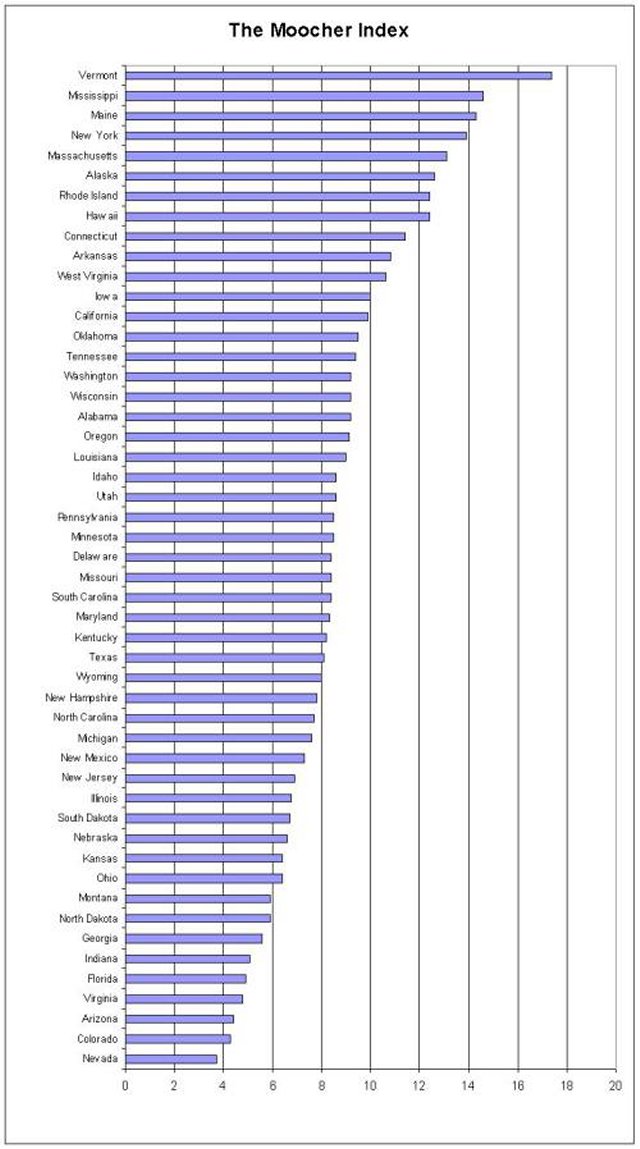
On February 1, 2013 I listened to the Governor of Vermont proposing a negative income tax (called an earned income credit paid for by Vermont taxpayers) for low income wage earners in Vermont. Conservative's academic hero, Milton Friedman, proposed replacing national and state welfare systems with negative income taxes.
Negative Income Tax --- http://en.wikipedia.org/wiki/Negative_income_tax
The idea in Vermont is to create sufficient incentives to work so that Welfare recipients are worse off than if they have jobs.
This would perhaps be a great solution if all 50 states had similar negative income taxes. But the problem is that if only Vermont has both a very generous welfare system plus a generous negative income tax, Vermont will become a magnet for low income workers in surrounding states. This will drive up the unemployment rate in Vermont, and when the new low-income residents of Vermont lose their jobs, they will burden and already over-burdened Vermont State Welfare System.
It's not clear at all that a negative income tax will work in the United States unless virtually all states have a similar negative income taxes in place.
Also it's not clear that it will work well in states that also have the highest state taxes like California, Illinois, Vermont, and Taxachusetts. Adding more taxation to pay for the negative income tax simply puts up more barriers to economic development that will employ low income workers.
"How Government Handouts Create Life-Sapping Dependency," by Daniel J.
Mitchell, Town Hall, February 8, 2013 ---
Click Here
http://finance.townhall.com/columnists/danieljmitchell/2013/02/08/how-government-handouts-create-lifesapping-dependency-n1507652?utm_source=thdaily&utm_medium=email&utm_campaign=nl
"America’s Future? Look to Illinois," by Fritz Pfister,
Townhall, January 11, 2013 ---
Click Here
http://finance.townhall.com/columnists/fritzpfister/2013/01/11/americas-future-look-to-illinois-n1486915?utm_source=thdaily&utm_medium=email&utm_campaign=nl
Somewhere along the line I remember a song about how you can take the kid out of the country, but you can’t take the country out of the kid. Guess one could write a song, you can take the kid out of Chicago but you can’t take Chicago out of the kid.
In October of 2008 my warnings went unheeded regarding candidate Barack Obama. All one needed do to see America in four years was to look at Blagojevich’s Illinois. It turned out worse than imagined.
Blagojevich’s Illinois was reeling in corruption, political favoritism, extra constitutional mandates, and unfunded pension liabilities growing exponentially due to quid pro quo union contracts.
Blago was a living example of liberal economic illiteracy when he quadrupled fees on trucking companies not realizing trucks have wheels, and 25,000 jobs were lost overnight. The exodus from Illinois was underway.
After getting caught with something ‘golden’ Blago was impeached, tried, and sent to prison leaving behind a state in financial shambles.
Enter Pat Quinn from Chicago. Another graduate of the Chicago School for Liberal Economic Illiteracy Quinn shoved through the biggest tax increase in Illinois history during a lame duck session.
That was in January 2011 with projected revenues that would solve all Illinois’ money woes with $7 billion in new revenue. By the end of 2011 the tax increased revenue by only $6 billion, and Quinn began his version of austerity measures which of course failed.
To see where Obama is taking America look to Illinois at the end of 2012. Here’s the report card; unfunded pension obligations up, budget deficit up, deficit spending up, unpaid bills to state vendors up, credit downgrade probable, talk of more taxes.
You can expect the same results from the economic illiterate in DC as the economic illiterate in Illinois. Obama’s attack on the wealthy with the cliff tax deal, and new Obamacare taxes will kill jobs too, just on a grander scale.
Obama must have at least one liberal adviser with a calculator because the day after raising taxes over $600 billion on the wealthy Obama was calling for a trillion more in revenue by eliminating deductions for the evil rich who are keeping the economy down.
Liberal hopes were dashed during the just concluded lame duck session in Illinois. While the state is bursting into flames of insolvency citizens were aghast that the lame duckers didn’t move on pension reform, gay marriage, and bans on assault weapons.
Continued in article
Bob Jensen's threads on entitlements are at
http://www.trinity.edu/rjensen/Entitlements.htm
The city uses bankruptcy to stiff bondholders but preserve pensions.
"Stockton Tries a Chrysler," The Wall Street Journal, December 30,
2012 ---
http://professional.wsj.com/article/SB10000872396390443931404577552980765823456.html?mg=reno64-wsj#mod=djemEditorialPage_t
The municipal bankruptcy unfolding in Stockton, California is giving investors a bad case of deja vu. Just as the Obama Administration bailed out the United Auto Workers in Chrysler's bankruptcy while hanging bondholders out to dry, the city of Stockton is subordinating its bond debt to worker pensions. But what's really scary is that the Stockton case could be replayed in dozens of California cities.
The San Joaquin Valley's second largest city filed for Chapter 9 bankruptcy this summer after a three-month mediation with creditors and unions ended in stalemate. Bond insurers that guarantee about $200 million in debt wouldn't submit to a haircut unless the rich pensions that helped drive the city to bankruptcy were also clipped. Yet unions wouldn't countenance an even modest reduction to their pensions.
Over the last two decades the city sweetened benefits and pay such that the average firefighter's total compensation is more than three times the city's median household income. Public safety officers can retire at age 50 with pensions equal to 90% of their highest salary, and until this year free lifetime health benefits. These benefits weren't sustainable even in good times. In 2007 the city had to borrow $127 million to pay a delinquent pension bill.
The city issued these pension obligation bonds which temporarily juiced city coffers and served as an arbitrage tool for city politicians who wanted to get in on the booming stock market. Stockton officials bet they could save money by borrowing at a rate 200 basis points below the 7.75% yield that the California Public Employees' Retirement System promised and invest the bond proceeds in the pension fund. But Calpers's actual returns have fallen short of the city's borrowing costs, so Stockton's total debt has increased.
Unions claim it's unfair to trim pensions since the city intends to terminate retiree health benefits. But few comparable California cities (and even fewer companies) provide retirees with medical benefits, and most pensioners will be eligible for Medicare or federal subsidies on the new state health exchange. When companies can't pay their bills, they usually freeze or terminate their pension plans and restructure benefits as part of bankruptcy.
Instead Stockton is seeking to use bankruptcy to wipe out $197.5 million in principal and interest on the pension obligation bonds it issued in 2007. But not so fast. Bond insurer Assured Guaranty has challenged the city's attempt to "transfer the cost of lucrative, above-market employee wages and benefits, granted when tax revenues were flush, to capital market creditors by haircutting bond principal." In none of the 43 municipal bankruptcy filings over the last three decades has principal been slashed.
Assured Guaranty fears that other cities will follow Stockton's bad example. The Bay Area suburb of Vallejo set that precedent four years ago when the union-influenced Calpers threatened litigation if the city attempted to modify pensions in bankruptcy. Calpers insisted that pensions were protected by the state constitution's contracts clause, though the very purpose of bankruptcy is to break and rewrite contracts.
Concern that insolvent cities might strategically declare bankruptcy to cancel their bond debts is finally getting noticed by investors, even by the famously late credit-rating agencies. "The recent uptick in bankruptcy filings in California could signify not only a lack of ability, but a lack of willingness to pay debt service at the expense of other financial obligations," Moody's MCO -0.78% prophesied earlier this year. Meanwhile, the Imperial Valley city of San Bernardino, having run out of cash, is going the Chapter 9 route.
Dozens of cities in California including Oakland, Sacramento and Los Angeles are slouching toward insolvency, but only a few such as San Jose and San Diego have taken on the unions and restructured worker retirement benefits. Many are instead borrowing to pay their retirement obligations just as Stockton did, thereby shifting the risk of paying for pensions to the bond markets. Oakland approved $210 million in pension obligation bonds this year, despite coming out $245 million behind after investing $417 million from a pension obligation bond sale in Calpers 15 years ago.
Once upon a time in America, a city that reneged on its bond debt would have taken decades to issue new debt, but Stockton's behavior suggests there is little such fear today. Investors who fail to impose discipline on deadbeats are likely to find the deadbeats playing them for suckers.
Ratings agencies downplay the "systemic risk" that the Stocktons of the United States pose to the $3.7 trillion municipal bond market. But then they also said mortgage-backed securities were Triple-A. While the market may not be in danger of blowing up soon, bondholders face a very real danger of being blown off to preserve worker pensions.
Jensen Comment
California residents suffer from the highest state and local taxes in the
USA. Those taxes are going to soar even higher to cover the increased costs
of borrowing by California's concessions to public worker labor unions. I
wonder how many of those retirees will choose to collect their pensions
outside the State of California. Almost certainly few of them will retire in
Stockton.
96% of the faculty and staff at Ivy League colleges
that contributed to the 2012 presidential race donated to President Obama's
campaign, reveals a Campus Reform investigation compiled using numbers released
by the Federal Election Commission (FEC). From the eight elite schools,
$1,211,267 was contributed to the Obama campaign, compared to the $114,166 given
to Romney. The highest percentage of Obama donors came from Brown University and
Princeton, with 99 percent of donations from faculty and staff going towards his
campaign.
Oliver Darcey, November 24, 2012 ---
http://www.campusreform.org/blog/?ID=4511
"Moving Further to the Left," by Scott Jaschik, Inside Higher Ed,
October 24, 2012 ---
http://www.insidehighered.com/
The President's proposal for taxing the top two percent of taxpayers leaves at best 94% of the deficit to be reduced by other means. This 94% is overly optimistic since the high income earners will move heavily into tax avoidance alternatives such as investments in tax-exempt securities and tax deferral alternatives such as long-term investments in precious metals, paintings, and other deferral and inflation-hedging alternatives that will do nothing for deficit relief for decades. It's misleading to claim the purpose of taxing the top two percent is to reduce the deficit.
Howard Dean
Democratic Party Governor of Vermont for Six Terms
Former head of the Democratic Committee
2004 Democratic Party Presidential Contender)
http://en.wikipedia.org/wiki/Howard_Dean
Howard Dean gets real and says something on MSNBC that I agree with
entirely: MSNBC did not want to hear this.
Last night ABC News showed a clip of former President Bill Clinton saying
the same thing
"Dean Exposes Obama's Need For Middle Class Tax Hike," December 6,
2012 ---
http://news.investors.com/ibd-editorials/120612-636087-democrats-dirty-little-secret-middle-class-tax-increases-ahead.htm
Taxes: The president says all he wants is for "the wealthiest Americans to pay a little more." But far-left Howard Dean just reminded us Obama wants a lot more from all taxpayers.
Interviewed by MSNBC's Lawrence O'Donnell on Wednesday, the ex-Vermont governor and 2004 Democratic presidential candidate shocked many with comments that really should have shocked no one.
"This is, initially, gonna seem like heresy from a progressive," Dean said. "The truth is, everybody needs to pay more taxes, not just the rich. That's a good start, but we're not gonna get out of this deficit problem unless we raise taxes across the board."
Dean added, "I actually have mixed feelings about striking a deal where the rich folks pay more taxes," preferring to go over the cliff at the end of the year.
Spending cuts were Dean's chief concern, but selectively so. Pining for Pentagon cuts, Dean had this sneer for the military: "They just ordered new uniforms for their chauffeurs for the top brass."
Adding her intellectual weight on O'Donnell's program was MSNBC commentator Krystal Ball (her real name), whose 15 minutes of infamy came in 2010.
That's when sexually-explicit photos of her surfaced during her far-left Democratic campaign for a redder-than-red Virginia congressional seat, in which she picked up just 35% of the vote.
According to Krystal's crystal ball, "We probably will have to raise taxes on a lot of people."
More taxes for a lot of people? We never heard that during the presidential campaign.
As the Cato Institute's Dan Mitchell recently pointed out, "stealing every penny from every millionaire would run the federal government for only three months." But as Mitchell noted, all along there have been "honest folks on the left who admit that they want ordinary people on the chopping block":
• Second-ranking House Democrat Steny Hoyer of Maryland two years ago said tax cuts benefiting the middle class should not be "totally sacrosanct."
• Jared Bernstein, who used to be Vice President Joseph Biden's economist, wrote in the Financial Times in August that Obama "will have to include tax increases beyond just the wealthiest households, although that is the right place to start," because "we're way below where we need to be in terms of revenue collection."
• In 2010, the New York Times editorial page warned that "more Americans — and not just the rich — are going to have to pay more taxes."
Case Studies in Gaming the Income Tax Laws ---
http://www.cs.trinity.edu/~rjensen/temp/TaxNoTax.htm
Harvard's token, albeit an unwanted token conservative, Harvey Mansfield is known for such things as assigning two grades to students (the A grades they get because Harvard expects that they will always get A grades and the (private) C grades they really earned). Much to the dismay of most faculty and administration at Harvard, he's an extremely popular teacher and renowned conservatism scholar.
Larry Summers, while President of Harvard University, purportedly tried to engineer a way to fire the outspoken Professor Mansfield. Mansfield himself believes such accusations are a bit over the top.
Harvey Mansfield is the William R. Kenan,
Jr. Professor of Government at Harvard University, where he has taught since
1962 ---
http://en.wikipedia.org/wiki/Harvey_Mansfield Optimism for the Future
"The Crisis of American Self-Government: Harvey Mansfield,
Harvard's 'pet dissenter,' on the 2012 election, the real cost of
entitlements, and why he sees reason for hope,": by by Sohrab Ahmari,
The Wall Street Journal, November 30, 2012 ---
http://professional.wsj.com/article/SB10001424127887323751104578149292503121124.html?mod=djemEditorialPage_t&mg=reno-wsj
'We have now an American political party and a European one. Not all Americans who vote for the European party want to become Europeans. But it doesn't matter because that's what they're voting for. They're voting for dependency, for lack of ambition, and for insolvency."
Few have thought as hard, or as much, about how democracies can preserve individual liberty and national virtue as the eminent political scientist Harvey Mansfield. When it comes to assessing the state of the American experiment in self-government today, his diagnosis is grim, and he has never been one to mince words.
Mr. Mansfield sat for an interview on Thursday at the Harvard Faculty Club. This year marks his 50th as a teacher at the university. It isn't easy being the most visible conservative intellectual at an institution that has drifted ever further to the left for a half-century. "I live in a one-party state and very much more so a one-party university," says the 80-year-old professor with a sigh. "It's disgusting. I get along very well because everybody thinks the fact that I'm here means the things I say about Harvard can't be true. I am a kind of pet—a pet dissenter."
Partly his isolation on campus has to do with the nature of Mr. Mansfield's scholarship. At a time when his colleagues are obsessed with trendy quantitative methods and even trendier "identity studies," Mr. Mansfield holds steadfast to an older tradition that looks to the Western canon as the best guide to human affairs. For him, Greek philosophy and the works of thinkers such as Machiavelli and Tocqueville aren't historical curiosities; Mr. Mansfield sees writers grappling heroically with political and moral problems that are timeless and universally relevant.
"All modern social science deals with perceptions," he says, "but that is a misnomer because it neglects to distinguish between perceptions and misperceptions."
Consider voting. "You can count voters and votes," Mr. Mansfield says. "And political science does that a lot, and that's very useful because votes are in fact countable. One counts for one. But if we get serious about what it means to vote, we immediately go to the notion of an informed voter. And if you get serious about that, you go all the way to voting as a wise choice. That would be a true voter. The others are all lesser voters, or even not voting at all. They're just indicating a belief, or a whim, but not making a wise choice. That's probably because they're not wise."
By that measure, the electorate that granted Barack Obama a second term was unwise—the president achieved "a sneaky victory," Mr. Mansfield says. "The Democrats said nothing about their plans for the future. All they did was attack the other side. Obama's campaign consisted entirely of saying 'I'm on your side' to the American people, to those in the middle. No matter what comes next, this silence about the future is ominous."
At one level Mr. Obama's silence reveals the exhaustion of the progressive agenda, of which his presidency is the spiritual culmination, Mr. Mansfield says. That movement "depends on the idea that things will get better and better and progress will be made in the actualization of equality." It is telling, then, that during the 2012 campaign progressives were "confined to defending what they've already achieved or making small improvements—student loans, free condoms. The Democrats are the party of free condoms. That's typical for them."
But Democrats' refusal to address the future in positive terms, he adds, also reveals the party's intent to create "an entitlement or welfare state that takes issues off the bargaining table and renders them above politics." The end goal, Mr. Mansfield worries, is to sideline the American constitutional tradition in favor of "a practical constitution consisting of progressive measures the left has passed that cannot be revoked. And that is what would be fixed in our political system—not the Constitution."
It is a project begun at the turn of the previous century by "an alliance of experts and victims," Mr. Mansfield says. "Social scientists and political scientists were very much involved in the foundation of the progressive movement. What those experts did was find ways to improve the well-being of the poor, the incompetent, all those who have the right to vote but can't quite govern their own lives. And still to this day we see in the Democratic Party the alliance between Ph.D.s and victims."
The Obama campaign's dissection of the public into subsets of race, sex and class resentments is a case in point. "Victims come in different kinds," says Mr. Mansfield, "so they're treated differently. You push different buttons to get them to react."
The threat to self-government is clear. "The American founders wanted people to live under the Constitution," Mr. Mansfield says. "But the progressives want the Constitution to live under the American people."
Harvey Mansfield Jr. was born in 1932 in New Haven, Conn. His parents were staunch New Dealers, and while an undergraduate at Harvard Mr. Mansfield counted himself a liberal Democrat.
Next came a Fulbright year in London and a two-year stint in the Army. "I was never in combat," he says. "In fact I ended up in France for a year, pulling what in the Army they call 'good duty' at Orléans, which is in easy reach of Paris. So even though I was an enlisted man I lived the life of Riley."
A return to the academy and a Harvard doctorate were perhaps inevitable but Mr. Mansfield also underwent a decisive political transformation. "I broke with the liberals over the communist issue," he says. "My initiating forces were anticommunism and my perception that Democrats were soft on communism, to use a rather unpleasant phrase from the time—unpleasant but true." He also began to question the progressive project at home: "I saw the frailties of big government exposed, one after another. Everything they tried didn't work and in fact made us worse off by making us dependent on an engine that was getting weaker and weaker."
His first teaching post came in 1960 at the University of California, Berkeley. In California, he came to know the German-American philosopher Leo Strauss, who at the time was working at Stanford University. "Strauss was a factor in my becoming conservative," he says. "That was a whole change of outlook rather than a mere question of party allegiance."
Strauss had studied ancient Greek texts, which emphasized among other things that "within democracy there is good and bad, free and slave," and that "democracy can produce a slavish mind and a slavish country." The political task before every generation, Mr. Mansfield understood, is to "defend the good kind of democracy. And to do that you have to be aware of human differences and inequalities, especially intellectual inequalities."
American elites today prefer to dismiss the "unchangeable, undemocratic facts" about human inequality, he says. Progressives go further: "They think that the main use of liberty is to create more equality. They don't see that there is such a thing as too much equality. They don't see limits to democratic equalizing"—how, say, wealth redistribution can not only bankrupt the public fisc but corrupt the national soul.
"Americans take inequality for granted," Mr. Mansfield says. The American people frequently "protect inequalities by voting not to destroy or deprive the rich of their riches. They don't vote for all measures of equalization, for which they get condemned as suffering from false consciousness. But that's true consciousness because the American people want to make democracy work, and so do conservatives. Liberals on the other hand just want to make democracy more democratic."
Equality untempered by liberty invites disaster, he says. "There is a difference between making a form of government more like itself," Mr. Mansfield says, "and making it viable." Pushed to its extremes, democracy can lead to "mass rule by an ignorant, or uncaring, government."
Consider the entitlements crisis. "Entitlements are an attack on the common good," Mr. Mansfield says. "Entitlements say that 'I get mine no matter what the state of the country is when I get it.' So it's like a bond or an annuity. What the entitlement does is give the government version of a private security, which is better because the government provides a better guarantee than a private company can."
That is, until the government goes broke, as has occurred across Europe.
"The Republicans should want to recover the notion of the common good," Mr. Mansfield says. "One way to do that is to show that we can't afford the entitlements as they are—that we've always underestimated the cost. 'Cost' is just an economic word for the common good. And if Republicans can get entitlements to be understood no longer as irrevocable but as open to negotiation and to political dispute and to reform, then I think they can accomplish something."
The welfare state's size isn't what makes it so stifling, Mr. Mansfield says. "What makes government dangerous to the common good is guaranteed entitlements, so that you can never question what expenses have been or will be incurred." Less important at this moment are spending and tax rates. "I don't think you can detect the presence or absence of good government," he says, "simply by looking at the percentage of GDP that government uses up. That's not an irrelevant figure but it's not decisive. The decisive thing is whether it's possible to reform, whether reform is a political possibility."
Then there is the matter of conservative political practice. "Conservatives should be the party of judgment, not just of principles," he says. "Of course there are conservative principles—free markets, family values, a strong national defense—but those principles must be defended with the use of good judgment. Conservatives need to be intelligent, and they shouldn't use their principles as substitutes for intelligence. Principles need to be there so judgment can be distinguished from opportunism. But just because you give ground on principle doesn't mean you're an opportunist."
Nor should flexibility mean abandoning major components of the conservative agenda—including cultural values—in response to a momentary electoral defeat. "Democrats have their cultural argument, which is the attack on the rich and the uncaring," Mr. Mansfield says. "So Republicans need their cultural arguments to oppose the Democrats', to say that goodness or justice in our country is not merely the transfer of resources to the poor and vulnerable. We have to take measures to teach the poor and vulnerable to become a little more independent and to prize independence, and not just live for a government check. That means self-government within each self, and where are you going to get that except with morality, responsibility and religion?"
So is it still possible to pull back from the brink of America's Europeanization? Mr. Mansfield is optimistic. "The material for recovery is there," he says. "Ambition, for one thing. I teach at a university where all the students are ambitious. They all want to do something with their lives." That is in contrast to students he has met in Europe, where "it was depressing to see young people with small ambitions, very cultivated and intelligent people so stunted." He adds with a smile: "Our other main resource is the Constitution."
F**k Up That Professor Mansfield!
And to think it was a questionable comment of women that got this President
of Harvard Fired
It seems like conservative men had a better case, at least one man
"White House economist: 'F--- up' conservative prof 'I was astounded that
the president of Harvard would stoop to such tactics'," WorldNetDaily,
December 6, 2009 ---
http://www.wnd.com/index.php?fa=PAGE.view&pageId=118187
According to a university colleague, former president of Harvard and current White House economist Larry Summers once asked for help to "f--- up" one of the school's conservative professors.
Summers' colleague, Cornel West, is a radical race relations instructor who is now a professor at Princeton after departing Harvard in the wake of a dispute with Summers. Obama named West, whom he has called a personal friend, to the Black Advisory Council of his presidential campaign. West was a key point man between Obama's campaign and the black community.
In his recently released memoirs, "Brother West: Living and Loving Out Loud," West claims that Summers invited West into his office and asked him to help undermine Harvard government professor Harvey Mansfield, who had professed conservative views.
"Help me f--- him up," Summers reportedly said to West without explaining further.
West writes, "For my part, I was astounded that the President of Harvard would stoop to such tactics."
West further related the details of the alleged encounter in a recent interview with Amy Goodman, host of the far-left Democracy Now Internet television network.
Said West: "And as soon as I walked into the office, [Summers] starts using profanity about Harvey Mansfield. I said, 'No, Harvey Mansfield is conservative, sometimes reactionary, but he's my dear brother.' We had just had debates at Harvard. Twelve hundred people showed up. He was against affirmative action; I was for it. That was fine. Harvey Mansfield and I go off and have a drink after, because we have a respect, but deep, deep philosophical and ideological disagreement. He was using profanity, so I had to defend Harvey Mansfield."
"Wait, so you're saying Lawrence Summers was using profanity?" Goodman asked.
Continued West: "Larry Summers using profanity about, you know, 'help me 'F' so and so up.' No, I don't function like that. Maybe he thought that just as a black man, I like to use profanity. I'm not a puritan. I don't use it myself. I have partners who do."
In response to West's claimed meeting with Summers, Mansfield told WND, "Larry Summers was not out to get me."
"I was not present at the famous interview between him and Cornel West, but in my opinion (Summers) merely used my name in a clumsy attempt to cajole Cornel West into behaving more like a professor, less like a celebrity," said Mansfield.
"Larry Summers was doing many good things at Harvard before his enemies there succeeded in ousting him," Mansfield added.
Neither Summers nor West immediately returned WND e-mail and phone requests for comment.
Mansfield is well-known for his opposition to grade inflation at Harvard, which he has publicly blamed in part on affirmative action. His views led to student protests and a well-attended debate with West.
Mansfield also defended President Bush's use of executive powers and has been criticized by some leading feminists for his views on gender roles. He has made statements that men and women have some different societal roles and wrote a book, "Manliness," in which he bemoaned the loss of the virtue of "manliness" in a "gender neutral" society.
Summers, meanwhile, continues to teach at Harvard but lost his position as president in part after a public feud in which West accused him of racism. Summers serves as director of the White House's National Economic Council.
West served as an adviser on Louis Farrakhan's Million Man March and is a personal friend of Farrakhan. He authored two books on race with Henry Louis Gates Jr., who last summer was at the center of controversy after Obama remarked on the Harvard professor's arrest.
Continued in article
"Sociology and Other 'Meathead'
Majors: Archie Bunker was right to be skeptical of his son-in-law's
opinions," by Harvey Mansfield, The Wall Street Journal,
May 31, 2011 ---
http://online.wsj.com/article/SB10001424052702304520804576345632061434312.html?_nocache=1306940719500#&mg=com-wsj
College campuses display a
striking uniformity of thought
Harvard professor Harvey Mansfield once famously
advised a conservative colleague to wait until he had tenure and only then
to "hoist the Jolly Roger." But few professors are getting around to
hoisting the Jolly Roger at all. Either they don't have a viewpoint that is
different from their colleagues, or they've decided that if they are going
to remain at one place for several decades, they'd rather just get along. Is
tenure to blame for the unanimity of thinking in American universities? It's
hard to tell. But shouldn't the burden of proof be on the people who want
jobs for life?
Naomi Schafer Riley, "Tenure and Academic Freedom: College campuses display
a striking uniformity of thought," The Wall Street Journal, June 23,
2009 ---
http://online.wsj.com/article/SB124571593663539265.html#mod=djemEditorialPage
Bob Jensen's threads on Harvey Mansfield ---
http://www.trinity.edu/rjensen/HigherEdControversies.htm
What you most likely will never hear on MSNBC: It's union against
union in the Hostess bankruptcy filing
"Jenkins: The Media Choke on a Twinkie --- Why nobody is allowed to hear what
the bakery union is saying," by Holman W. Jenkins, The Wall Street
Journal, November 27, 2012 ---
http://professional.wsj.com/article/SB10001424127887324469304578145102007752448.html?mod=djemEditorialPage_t&mg=reno-wsj
Hardly any business in America is less consequential than Hostess, and yet Twinkies have garnered a disproportionate share of media focus and we are about to recommit the sin of over-attention here.
Our most fervent wish for the journalism profession for a long while has been that a new generation would come along trained to think. The world is adequately stocked with journalists who can write, who are careful and accurate reporters, and yet are helpless as babies when asked to punch their way through an obvious fallacy.
Hostess has been enveloped in arguments about whether management or labor is to blame for the company’s downfall. You can guess where most treatments come down. Management did not invest enough in new products or upgraded software or new trucks. Begged by these indictments is the question of whether managers stupidly refused to make profitable investments or were somehow incentivized to prefer losing money. If not, one might have to entertain the possibility that management was doing the job of management, withholding investment in a business model that would not return that investment with a profit.
Where wealth and livelihood are entailed, where teams act together and have time and incentive to think carefully, a good assumption is that people—management, labor—act rationally. Unfortunately, journalists who might be prepared to brave bullets in a war zone nonetheless lack simple courage to see what’s in front of their eyes in a matter like the Twinkies bankruptcy. The reason is endemic: Not enough is at stake for the media itself to cause the media to prefer an uncomfortable truth when a comfortable fallacy is at hand.
Nevertheless, one of the major parties to the Twinkie bankruptcy, the bakery union, has been unstinting in explaining the company’s trouble in written and spoken word to anyone who wants to listen. The Hostess brands are valuable. The Hostess bakery and packaging operations are reasonably competitive and efficient, and while some reorganization and downsizing are inevitable, these properties are still worth owning.
Hostess’s problem, as the bakers point out in bankruptcy filings printed in legible English, and as Hostess management has pointed out in its own equally readable filings, is that Hostess’s valuable parts are held back by Hostess’s high-cost, Teamster-staffed system for moving Twinkies and other delights from production facility to store shelf.
This high-cost distribution system means the company doesn’t make money on many of its existing sales. It means it can’t profitably extend sales to new customers and new geographical markets that might keep Hostess factories busier than ever.
Now, as we said, a good bet is that people act rationally where their material interests are concerned. The bakers make a perfectly rational judgment, in rejecting further concessions and triggering the liquidation of Hostess, that their members would be better off if no longer wedded to Hostess’s Teamster-dominated delivery network.
The Teamsters, who swallowed hard and agreed to concessions in hopes of avoiding liquidation, are telling you something too. The Teamsters are telling you, quite rationally, that nothing of value would likely remain in the Hostess distribution system in a liquidation. Look at the buyers lining up for the Hostess brands, such as Tastykake owner Flower Foods and the investment fund that owns Pabst Blue Ribbon, who slaver after an opportunity to roll Twinkies and related indulgences into their own existing delivery networks. They slaver after Hostess’s distribution operations not at all.
Or turn on any business channel or any football game. Bombarding you will be ads from UPS, FedEx FDX +0.27% and the U.S. Postal Service aimed not at consumers but at business managers. These ads sing jingles about “logistics.” They show how over-caffeinated coffee warehouse managers can improve profits by outsourcing shipping to the professionals.
These commercials exist for a reason. Both the bakers and Teamsters judge their interests rightly. The Teamsters see little hope of survival if Hostess liquidates and the bakers see little hope of survival if it doesn’t. Sadly, Hostess’s outdated distribution business has all the entrepreneurial appeal these days of a tube-TV factory.
It’s even possible that management is right too, though some executives may wear suits, which makes them baddies: To invest more money in Hostess as currently structured would be to throw good money after bad.
Continued in article
Jensen Comment
Lost in all of this dialog is that the roaring price of sugar and other
ingredients in Hostess products may have had as much or more to do with this
declaration of bankruptcy. Twinkies, for example, are far from being a food
essential. As such the demand is price elastic in the sense that if the
price of a package of Tinkies soars the demand will fall off rather sharply,
especially amidst in this era when the media bombards us with warnings about
the obesity epidemic and how sugar is bad for health.
The real culprits in the demise of Hostess may well be as follows:
- The U.S. sugar beet farmers who successfully lobbied for tariff
walls preventing cheaper foreign-produced sugar from entering the U.S.
- The FDA that keeps hammering against unnecessary high-sugar drinks
and foods.
- The bakery union that resisted more cost efficient automation in Hostess plants.
It remains to be seen whether other companies can make Hostess-product brand names more profitable. If they do so, it will probably be mostly due to automation.
"Pew: MSNBC's Bias Far Worse Than Fox," by Warner Todd Huston,
Breitbart, November 3, 2012 ---
http://www.breitbart.com/Big-Journalism/2012/11/02/Pew-MSNBC-s-Bias-Far-Worse-Than-Fox
This news is certainly no surprise to anyone on the right, but a new Pew study finds that MSNBC is far more biased than Fox News.
The Pew study, Winning The Media Campaign 2012, tracked the political coverage that President Obama and GOP nominee Mitt Romney received between the conventions and the final days of the campaign. The study of the media landscape (including social media) shows that Obama got a bit more positive coverage than Mitt Romney, but that his positive coverage took a nosedive after his miserable performance at the first debate.
But one of the more interesting aspects of the Pew study is the breakdown of bias from MSNBC and Fox News. This part of the study shows that MSNBC was far more biased against Romney than Fox was against Obama.
MSNBC featured 71 percent negative coverage of Mitt Romney, whereas Fox coverage of Obama was only 46 percent unfavorable. What's more, positive Romney stories on MSNBC reached all the way to a soaring three percent!
David Zurawik of the Baltimore Sun exactly pegs these results. Of MSNBC, Zurawik says, "That's not a news channel."
That's a propaganda machine, and owner Comcast should probably change [MSNBC President] Phil Griffin's title from president to high minister of information, or something equally befitting the work of a party propaganist [sic] hack in a totalitarian regime. You wonder how mainstream news organizations allow their reporters and corrdespondents [sic] to appear in such a cauldron of bias.
Why some viewers consider commentators such as Chris "Tingles" Matthews, Ed Schultz, or Rachel Maddow anything other than complete propagandists is anyone's guess, but this Pew study proves beyond a shadow of a doubt that there isn't a single unbiased minute on MSNBC, while Fox News appears to be far more balanced by comparison.
Continued in article
Bob Jensen's threads on liberal bias in the media and in academe are
at
http://www.trinity.edu/rjensen/HigherEdControversies.htm#LiberalBias
"How Free Speech Died on Campus A young activist describes how
universities became the most authoritarian institutions in America," by
Sohab Ahmarik, The Wall Street Journal, November 16m 2012 ---
http://professional.wsj.com/article/SB10001424127887323894704578115440209134854.html?mod=djemEditorialPage_t&mg=reno-wsj
At Yale University, you can be prevented from putting an F. Scott Fitzgerald quote on your T-shirt. At Tufts, you can be censured for quoting certain passages from the Quran. Welcome to the most authoritarian institution in America: the modern university—"a bizarre, parallel dimension," as Greg Lukianoff, president of the Foundation for Individual Rights in Education, calls it.
Mr. Lukianoff, a 38-year-old Stanford Law grad, has spent the past decade fighting free-speech battles on college campuses. The latest was last week at Fordham University, where President Joseph McShane scolded College Republicans for the sin of inviting Ann Coulter to speak.
"To say that I am disappointed with the judgment and maturity of the College Republicans . . . would be a tremendous understatement," Mr. McShane said in a Nov. 9 statement condemning the club's invitation to the caustic conservative pundit. He vowed to "hold out great contempt for anyone who would intentionally inflict pain on another human being because of their race, gender, sexual orientation, or creed."
To be clear, Mr. McShane didn't block Ms. Coulter's speech, but he said that her presence would serve as a "test" for Fordham. A day later, the students disinvited Ms. Coulter. Mr. McShane then praised them for having taken "responsibility for their decisions" and expressing "their regrets sincerely and eloquently."
Mr. Lukianoff says that the Fordham-Coulter affair took campus censorship to a new level: "This was the longest, strongest condemnation of a speaker that I've ever seen in which a university president also tried to claim that he was defending freedom of speech."
I caught up with Mr. Lukianoff at New York University in downtown Manhattan, where he was once targeted by the same speech restrictions that he has built a career exposing. Six years ago, a student group at the university invited him to participate in a panel discussion about the Danish cartoons depicting the Prophet Muhammad that had sparked violent rioting by Muslims across the world.
When Muslim students protested the event, NYU threatened to close the panel to the public if the offending cartoons were displayed. The discussion went on—without the cartoons. Instead, the student hosts displayed a blank easel, registering their own protest.
"The people who believe that colleges and universities are places where we want less freedom of speech have won," Mr. Lukianoff says. "If anything, there should be even greater freedom of speech on college campuses. But now things have been turned around to give campus communities the expectation that if someone's feelings are hurt by something that is said, the university will protect that person. As soon as you allow something as vague as Big Brother protecting your feelings, anything and everything can be punished."
You might say Greg Lukianoff was born to fight college censorship. With his unruly red hair and a voice given to booming, he certainly looks and sounds the part. His ethnically Irish, British-born mother moved to America during the 1960s British-nanny fad, while his Russian father came from Yugoslavia to study at the University of Wisconsin. Russian history, Mr. Lukianoff says, "taught me about the worst things that can happen with good intentions."
Growing up in an immigrant neighborhood in Danbury, Conn., sharpened his views. When "you had so many people from so many different backgrounds, free speech made intuitive sense," Mr. Lukianoff recalls. "In every genuinely diverse community I've ever lived in, freedom of speech had to be the rule. . . . I find it deeply ironic that on college campuses diversity is used as an argument against unbridled freedom of speech."
After graduating from Stanford, where he specialized in First Amendment law, he joined the Foundation for Individual Rights in Education, an organization co-founded in 1999 by civil-rights lawyer Harvey Silverglate and Alan Charles Kors, a history professor at the University of Pennsylvania, to counter the growing but often hidden threats to free speech in academia. FIRE's tactics include waging publicity campaigns intended to embarrass college administrators into dropping speech-related disciplinary charges against individual students, or reversing speech-restricting policies. When that fails, FIRE often takes its cases to court, where it tends to prevail.
In his new book, "Unlearning Liberty," Mr. Lukianoff notes that baby-boom Americans who remember the student protests of the 1960s tend to assume that U.S. colleges are still some of the freest places on earth. But that idealized university no longer exists. It was wiped out in the 1990s by administrators, diversity hustlers and liability-management professionals, who were often abetted by professors committed to political agendas.
"What's disappointing and rightfully scorned," Mr. Lukianoff says, "is that in some cases the very professors who were benefiting from the free-speech movement turned around to advocate speech codes and speech zones in the 1980s and '90s."
Today, university bureaucrats suppress debate with anti-harassment policies that function as de facto speech codes. FIRE maintains a database of such policies on its website, and Mr. Lukianoff's book offers an eye-opening sampling. What they share is a view of "harassment" so broad and so removed from its legal definition that, Mr. Lukianoff says, "literally every student on campus is already guilty."
At Western Michigan University, it is considered harassment to hold a "condescending sex-based attitude." That just about sums up the line "I think of all Harvard men as sissies" (from F. Scott Fitzgerald's 1920 novel "This Side of Paradise"), a quote that was banned at Yale when students put it on a T-shirt. Tufts University in Boston proscribes the holding of "sexist attitudes," and a student newspaper there was found guilty of harassment in 2007 for printing violent passages from the Quran and facts about the status of women in Saudi Arabia during the school's "Islamic Awareness Week."
At California State University in Chico, it was prohibited until recently to engage in "continual use of generic masculine terms such as to refer to people of both sexes or references to both men and women as necessarily heterosexual." Luckily, there is no need to try to figure out what the school was talking about—the prohibition was removed earlier this year after FIRE named it as one of its two "Speech Codes of the Year" in 2011.
At Northeastern University, where I went to law school, it is a violation of the Internet-usage policy to transmit any message "which in the sole judgment" of administrators is "annoying."
Conservatives and libertarians are especially vulnerable to such charges of harassment. Even though Mr. Lukianoff's efforts might aid those censorship victims, he hardly counts himself as one of them: He says that he is a lifelong Democrat and a "passionate believer" in gay marriage and abortion rights. And free speech. "If you're going to get in trouble for an opinion on campus, it's more likely for a socially conservative opinion."
Consider the two students at Colorado College who were punished in 2008 for satirizing a gender-studies newsletter. The newsletter had included boisterous references to "male castration," "feminist porn" and other unprintable matters. The satire, published by the "Coalition of Some Dudes," tamely discussed "chainsaw etiquette" ("your chainsaw is not an indoor toy") and offered quotations from Teddy Roosevelt and menshealth.com. The college found the student satirists guilty of "the juxtaposition of weaponry and sexuality."
"Even when we win our cases," says Mr. Lukianoff, "the universities almost never apologize to the students they hurt or the faculty they drag through the mud." Brandeis University has yet to withdraw a 2007 finding of racial harassment against Prof. Paul Hindley for explaining the origins of "wetback" in a Latin-American Studies course. Indiana University-Purdue University Indianapolis apologized to a janitor found guilty of harassment—for reading a book celebrating the defeat of the Ku Klux Klan in the presence of two black colleagues—but only after protests by FIRE and an op-ed in these pages by Dorothy Rabinowitz.
What motivates college administrators to act so viciously? "It's both self-interest and ideological commitment," Mr. Lukianoff says. On the ideological front, "it's almost like you flip a switch, and these administrators, who talk so much about treating every student with dignity and compassion, suddenly come to see one student as a caricature of societal evil."
Continued in article
Ann Coulter --- http://en.wikipedia.org/wiki/Ann_Coulter
Michael Moore --- http://en.wikipedia.org/wiki/Michael_Moore
I'm not a huge Ann Coulter fan, and I seriously do not recall ever quoting her on the AECM or on my Website. However, the article below illustrates another way progressives on campus in the past are silencing conservative voices on campus. It's not just that the conservatism speakers that are being silenced, it's a message to conservative students that they should not be advocating conservatism.
It's OK to invite Michael Moore but not Ann Coulter.
It's not so much that both Coulter and Moore often violate the principles of good scholarship. The point is why is Moore so easily invited by liberal students on campus and Coulter repelled so often by faculty and administration on college campuses?
"A Different Ann Coulter Debate," by Scott Jaschik, Inside Higher
Ed, November 12, 2012 ---
http://www.insidehighered.com/news/2012/11/12/fordham-declines-ban-ann-coulter-her-invitation-rescinded
Bob Jensen's threads on liberal biases in the media and academe ---
http://www.trinity.edu/rjensen/HigherEdControversies.htm#LiberalBias
"Moving Further to the Left," by Scott Jaschik, Inside Higher Ed,
October 24, 2012 ---
http://www.insidehighered.com/
Academics, on average, lean to the left. A survey being released today suggests that they are moving even more in that direction.
Among full-time faculty members at four-year colleges and universities, the percentage identifying as "far left" or liberal has increased notably in the last three years, while the percentage identifying in three other political categories has declined. The data come from the University of California at Los Angeles Higher Education Research Institute, which surveys faculty members nationwide every three years on a range of attitudes.
Here are the data for the new survey and the prior survey:
2010-11 2007-8 Far left 12.4% 8.8% Liberal 50.3% 47.0% Middle of the road 25.4% 28.4% Conservative 11.5% 15.2% Far right 0.4% 0.7%
Gauging how gradual or abrupt this shift is complicated because of changes in the UCLA survey's methodology; before 2007-8, the survey included community college faculty members, who have been excluded since. But for those years, examining only four-year college and university faculty members, the numbers are similar to those of 2007-8. Going back further, one can see an evolution away from the center.
In the 1998-9 survey, more than 35 percent of faculty members identified themselves as middle of the road, and less than half (47.5 percent) identified as liberal or far left. In the new data, 62.7 percent identify as liberal or far left. (Most surveys that have included community college faculty members have found them to inhabit political space to the right of faculty members at four-year institutions.)
The new data differ from some recent studies by groups other than the UCLA center that have found that professors (while more likely to lean left than right) in fact were doing so from more of a centrist position. A major study in 2007, for example, found that professors were more likely to be centrist than liberal, and that many on the left identified themselves as "slightly liberal." (That study and the new one use different scales, making exact comparisons impossible.)
In looking at the new data, there is notable variation by sector. Private research universities are the most left-leaning, with 16.2 percent of faculty members identifying as far left, and 0.1 percent as far right. (If one combines far left and liberal, however, private, four-year, non-religious colleges top private universities, 58.6 percent to 57.7 percent.) The largest conservative contingent can be found at religious, non-Roman Catholic four-year colleges, where 23.0 percent identify as conservative and another 0.6 percent say that they are far right.
Professors' Political Identification, 2010-11, by Sector
Far left Liberal Middle of the Road Conservative Far right Public universities 13.3% 52.4% 24.7% 9.2% 0.3% Private universities 16.2% 51.5% 22.3% 9.8% 0.1% Public, 4-year colleges 8.8% 47.1% 28.7% 14.7% 0.7% Private, 4-year, nonsectarian 14.0% 54.6% 22.6% 8.6% 0.3% Private, 4-year, Catholic 7.8% 48.0% 30.7% 13.3% 0.3% Private, 4-year, other religious 7.4% 40.0% 29.1% 23.0% 0.6%
The study found some differences by gender, with women further to the left than men. Among women, 12.6 percent identified as far left and 54.9 percent as liberal. Among men, the figures were 12.2 percent and 47.2 percent, respectively.
When it comes to the three tenure-track ranks, assistant professors were the most likely to be far left, but full professors were more likely than others to be liberal.
Professors' Political Identification, 2010-11, by Tenure Rank
Far left Liberal Middle of the Road Conservative Far right Full professors 11.8% 54.9% 23.4% 9.7% 0.2% Associate professors 13.8% 50.4% 24.0% 11.5% 0.4% Assistant professors 13.9% 48.7% 25.9% 11.2% 0.4%
So what do these data mean?
Sylvia Hurtado, professor of education at UCLA and director of the Higher Education Research Institute, said that she didn't know what to make of the surge to the left by faculty members. She said that she suspects age may be a factor, as the full-time professoriate is aging, but said that this is just a theory. Hurtado said that these figures always attract a lot of attention, but she thinks that the emphasis may be misplaced because of a series of studies showing no evidence that left-leaning faculty members are somehow shifting the views of their students or enforcing any kind of political requirement.
Continued in article
"Noam Chomsky Spells Out the Purpose of Education," by Josh Jones,
Open Culture, November 2012 ---
http://www.openculture.com/2012/11/noam_chomsky_spells_out_the_purpose_of_education.html
Bob Jensen's threads on liberal biases in the media and academe ---
http://www.trinity.edu/rjensen/HigherEdControversies.htm#LiberalBias
From:
Bob Jensen [mailto:rjensen@trinity.edu]
Sent: Thursday, November 15, 2012
9:46 AM
To: David Johnstone
Subject: Re: FW: print this
FW: The real winner in the US
elections: Thomas Bayes
Hi David,
I agree that accountants, including me, are pretty ignorant of anything outside the GLM and their purchased databases.
My priors are that most of the polls are biased (in varying degrees in terms of particular polls and a given poll at certain points in time). The bias often is not even deliberate but more of a function of when voters are sampled on a cost-benefit basis. For example, respondents might answer differently on the phone than when confronted face-to-face where it's sometimes easier to detect lying. I know some folks who lie on the phone to political pollsters just to add error to the poll outcomes. It's malace rather than truth.
A huge problem is how to deal with randomly sampled respondents who simply slam the phone down refusing to participate in the poll. What error does this add to the poll outcomes. I believe that this phone slamming error varies with geographically and temporally. For example, voters in New England or Wyoming may be more inclined to phone slam than voters in Cleveland. Also a person receiving the third phone call in a week may be more inclined to phone slam vis-a-vis that first call.
There are also some mysterious "weightings" in some polls were Democrat respondents are weighted more heavily than Republicans and vice versa. I think this is common because of the problem of reaching some street people, nursing home patients, and students who are not easy to contact by phone (e.g., in dorms). Pollsters sometimes try to weight to compensate for that type of polling error.
I'm also suspicious of those polls that repeatedly reported 51% for Candidate X and 48% for Candidate Y. Do the pollsters really think that anybody with brains thinks the uncommitted independents are only 1% of the voting population? Give us a break!
There also is a problem in that there is probably more voting fraud on election day where some voting machines (like those in Cleveland in the 2012 election) and where those old Acorn folks give some voters multiple fake picture IDs and then pay them $10 for each time they vote.
I don't think your Bayesian devices for detecting bias dig deep enough into the bad data in the databases themselves.
Like I said, if you really want to make a better case for Silvers and Bayes, confine yourself to Silver's marvelous baseball studies having less biased fundamental data.
Venturing into political polls is tantamount to being sucked into quicksand.
I think you should post some of your excellent scholarship on this to the AECM. It would be especially enlightening if you reveal what you learned about about Bayes and baseball after reading Siver's book.
On Wed,
Nov 14, 2012 at 4:01 PM, David
Johnstone <david.johnstone@sydney.edu.au
Dear Bob, I did not know any of this background, so thankyou for putting things into clear perspective.
One technical point (that does not answer your criticisms totally) is that the Bayes mechanism of using likelihood p(signal|event) to find p(event|signal) is that built-in bias in the signal is accounted for logically in determining just how strong it is.
I didn’t forward the message to AECM because I did not think the crowd is keen for more Bayesian spruiking from me, and because I did not know too much about this Silver man. Your points make it clear that caution was justified.
I did know that you would be a good barometer though!
One thing I will say on another point, accounting as a discipline does not properly understand Bayes theorem, despite the amount of Bayesian argument/modelling. This is remarkable given that accounting is a signalling discipline. Foster was right when he started his Fin Stmt Analysis text with Ch.1 on Bayes and the value of info. I am just finishing up a couple of papers on this, so will send soon.
All the best, david
From:
Bob Jensen [mailto:rjensen@trinity.edu]
Sent: Wednesday,
November 14, 2012 10:09
PM
To: David
Johnstone
Subject: Re: FW:
print this FW: The real
winner in the US
elections: Thomas Bayes
I have no
suggestions on how
best to leverage
Silver's success
that you've not
thought of already.
Perhaps you should
forward this message
to the AECM.
For me, there's a
huge flaw in
Silver's political
forecasting. That is
the flaw of not
being in control of
the data collection.
He's an aggregator
of polls conducted
by others, and these
polls have a huge
moral hazard of
engineering
elections the way
they conduct their
polls.
Also, there are
bothersome
predictions of
Silver in the past
where he's accused
of lack of
independence himself
--- e.g., his
prediction of that
Scott Brown would
lose when in fact
Scott Brown won in
the first
replacement of Ed
Kennedy's longtime
Senate seat.
I think Silver's on
more solid ground in
baseball where he's
less biased and is
less dependent upon
flawed basic data.'
He may be on more
solid ground if he
pays more attention
to primary elections
within a given party
where the
liberal-conservative
biases are less
pronounced.
Thanks David,
It's always great to
learn from a pro.
On Tue, Nov 13,
2012 at 7:04 PM,
David Johnstone
<david.johnstone@sydney.edu.au
Dear Bob you
might like this.
David
-----Original
Message-----
From: ISBA
Webmaster [mailto:hans@stat.duke.edu]
Sent: Friday,
November 09,
2012 3:34 AM
To:
news@bayesian.org
Subject: The
real winner in
the US
elections:
Thomas Bayes
As we all know,
last night was
the US
presidential
election. In
one sense,
President Obama
was the winner.
But in another
sense, the real
winner was
Bayesian
analysis, which
scored a public
relations coup.
In 2008, Nate
Silver developed
a Bayesian model
to forecast the
U.S.
general election
results. He won
fame for
correctly
predicting 49 of
50 states, as
well as every
Senate race.
This brought
him a New York
Times column and
a much higher
profile.
This time
around, his
consistent
predictions that
Obama was in
front earned him
a considerable
backlash among
pundits. While
a few criticisms
had merit, most
were
mathematically
illiterate,
indignantly
mocking the idea
that the race
was anything
other than a
tossup. Now the
results are in,
and he has
predicted all 50
states
correctly.
People with our
quantitative
background can
easily find
flaws with this
metric. For
example, a
majority of
states were easy
to call --
nobody is
surprised by the
results in Texas
or California.
More seriously,
his "call" for
Florida was a
50.3%
probability,
essentially the
proverbial "coin
toss". Serious
analysis has to
chalk Florida up
to luck.
Nevertheless,
the broader
point is that
Nate's
high-profile
Bayesian model
just experienced
a very visible
success. Even
better, he
recently
authored a
book-length
popular
exposition of
the Bayesian
approach. I
purchased that
book, "The
Signal and the
Noise," on a
recent flight.
It's excellent
reading: more
technical than
McGrayne's
recent entry,
but no less
accessible or
engaging.
How can ISBA
leverage
Silver's success
to bring Bayes
to a wider
audience?
Charles Hogg
charles.r.hogg@gmail.com
******************************
ISBA now
maintains the
bayes-news and
Valencia email
lists; you are
receiving this
message as you
have opted-in to
receive email
from bayes-news,
the Valencia
list or the ISBA
forums. To opt
out or change
your email
subscriptions
please login at
http://bayesian.org/user.
Go to the My
Account menu and
select Forum
Email
Integration.
Check the forums
to which you
wish to
subscribe, then
save your
settings. You
may view past
and present
content at any
time by visiting
http://bayesian.org/forum
Dear Bob,
Thank you very much for this apolitical and very insightful accounting related post that your fellow conservative supporters on the forum love. I have no desire to turn it political.
If I may suggest, one solution could be for state legislatures to pass a law that would require the secretary of states to hire an accounting firm to manage, conduct and report on all elections. Accounting firms already have the vote collection and counting expertise with the Oscar, Emmy, and other similar events. Not to mention maintaining security and confidentiality. Accountants also have the reputation, public confidence, are apolitical and only interested in furthering the accounting profession and make money.
As to your complain about "Zafar did not answer my question concerning what aspects of conservatism he would allow if conservatives are going to have any voice in preventing the Democratic Party from becoming a monopoly in academe and government," may be another day, another time, or in private. Right now I have more pressing things to do (Tom and Jim and Pat can relax).
Respectfully,
Zafar
Sent: Thursday, November 15, 2012 6:46:49 AM
Subject: Re: 247,713 votes cast among 175,554 registered voters
Hopefully this will be my last message to this thread.The main problem with voting fraud is that voting laws are often not enforced.1. Over worked justice departments do not treat voting fraud as a priority given their bigger fish to fy, including murderers, drug crime leaders, extortionists, rapeists, child abusers, etc.
2. Voting fraud is much more difficult to enforce than such crimes as traffic violation.But it is inconceivable that our many corrupt elected and appointed government leaders are incapable of committing voting fraud to get elected. For example, two former Illinois governors are currently in prison for "more serious" crimes. Countless mayors, governors, and legislators are either in prison or are ex-convicts, including one of the most notorious extortion and bribery mayors (Detroit) recently sent to prison. Are these corrupt officials ipso facto incapable of voting/election fraud? I absolutely do not believe that. The problem is that voting fraud is not a priority in our justice system.I think we have a voting fraud problem because our justice departments refuse to make voting fraud a priority. Exhibit A is our current U.S. Attorney General.But enough of that and enough of politics.By the way Zafar did not answer my question concerning what aspects of conservatism he would allow if conservatives are going to have any voice in preventing the Democratic Party from becoming a monopoly in academe and government.Respectfully,
Bob Jensen
On Wed, Nov 14, 2012 at 7:00 PM, Zafar Khan <zkhan@emich.edu> wrote:
I agree but the question is will Bob listen to any one.
Zafar
From: "Patricia Walters" <patricia@DISCLOSUREANALYTICS.COM >
To: AECM@LISTSERV.AAAHQ.ORG
Sent: Wednesday, November 14, 2012 5:55:41 PM
Subject: Re: 247,713 votes cast among 175,554 registered voters
I second, third, and fourth Jim's motion.Thanks, Jim.Pat
From: Jim McKinney <jim@MCKINNEYCPA.COM>
To: AECM@LISTSERV.AAAHQ.ORG
Sent: Wednesday, November 14, 2012 4:51 PM
Subject: Re: 247,713 votes cast among 175,554 registered voters
Can we stop arguing politics in this forum except when it relates to the SEC, PCAOB, or accounting related. Where in Accounting Education using Computers and Multimedia does it mention politics. There are plenty of forums that discuss politics. I doubt there are more than one or two people who signed on to this forum because they want to discuss politics. I can bet that a number of educators have signed off this listserv because of the incessant political discussions. Please take the political discussions elsewhere and lets focus on Accounting Education using Computers and Multimedia .Jim McKinney, Ph.D., C.P.A.
Accounting and Information Assurance
Robert H. Smith School of Business
4333G Van Munching Hall
University of Maryland
College Park, MD 20742-1815
http://www.rhsmith.umd.edu/From: AECM, Accounting Education using Computers and Multimedia [mailto:AECM@LISTSERV.AAAHQ.ORG ] On Behalf Of Tom Oxner
Sent: Wednesday, November 14, 2012 5:34 PM
To: AECM@LISTSERV.AAAHQ.ORG
Subject: Re: 247,713 votes cast among 175,554 registered votersZafar, I am really tired of hearing you say "Bob, there you go again". The only idea that you EVER put forward is that nothing is ever the fault of the Democrats. When the Republicans have majorities in both houses of congress and the presidency: Everything bad that happens is the Republicans fault. When the Republicans have the presidency and the Dems have majorities in both houses of congress, everything bad that happens is the Republicans fault. When the Dems have the presidency and majorities in both houses of congress, everything bad that happens is the Republicans fault. When the Dems have the presidency and a majority in the senate, but not the house, everything bad that happens is the Republicans fault. I think I see a pattern here. While this may pass for insightful analysis in your eyes, it certainly does not in mine.The only person on this list guilty of "there you go again" is YOU. Your response to every situation is totally predictable.Tom Oxner
>>> Bob Jensen <rjensen@TRINITY.EDU> 11/14/2012 4:18 PM >>>Hi Zafar,This is not so much a political thread as it is an instructional thread for students of logic. Marc can chime in anytime.If I searched the Web and documented over 100 convictions for voting fraud with fines and jail time you would reply that's not enough.You miss my point --- the point being the fallacy of Democratic Party logic concerning voter fraud.There's a fallacy logic in the Democratic Party accusations.The Democratic Party officially blames the win of George W. Bush over Al Gore on voter fraud.
How can the Democratic Party later assert there is no serious voter fraud in America?I don't have to prove anything other than to cite hundreds of Democratic Party assertions on both sides of this fence. These are so so widely known that citation is superfluous on the AECM.I wonder why you don't want to address the fallacy in logic of first claiming Bush won only because of voter fraud and subsequently claiming there is no voter fraud.I realize you are trapped into a corner here and don't want to address this fallacy as an academic exercise.This is no change in subject. It's about an enormous fallacy in reasoning that would never be mentioned on MSNBC.From a Dartmouth-area hotelRespectfully,
Bob JensenOn Wed, Nov 14, 2012 at 9:37 AM, Zafar Khan <zkhan@emich.edu> wrote:Dear Bob,
I am tired of saying "there you go again."
We are talking about imagined voter fraud, allegations without evidence, not one or two or multiparty system. Please provide evidence and do not change topic.
You can start another thread on how many parties should be there.
ZafarFrom: "Bob Jensen" <rjensen@TRINITY.EDU>
To: AECM@LISTSERV.AAAHQ.ORGSent: Tuesday, November 13, 2012 6:48:15 PM
Subject: Re: 247,713 votes cast among 175,554 registered voters
I'm curious Zafar.
Are you arguing that the U.S. would be a better place if conservatives no longer had a voice in academe or government?
Should the Democratic Party emerge as the only party ruling America?On Tue, Nov 13, 2012 at 3:04 PM, Zafar Khan <zkhan@emich.edu> wrote:Bob wrote: "I think serious voting fraud in the U.S. goes undetected, and this fraud is bipartisan."
Bob,
There is no evidence of serious voter fraud. It is only an imagination of conservatives. I happened to listen to Bill Cunningham, the great American, Sunday while driving late night on I-69. Believe me it was hilarious, all the crazy explanations of why and how Obama won. He did mention, his audience mostly lack good education (reason why they may be gullible).
ZafarFrom: "Bob Jensen" <rjensen@TRINITY.EDU>
To: AECM@LISTSERV.AAAHQ.ORG
Sent: Sunday, November 11, 2012 5:55:54 PM
Subject: Re: 247,713 votes cast among 175,554 registered voters
Hi Dan,
I'm more of a skeptic. But that's probably because I lived in Texas so long. You must remember that in some counties in Texas assorted people have been voting from the grave for decades.
I once was on an audit of Gates Rubber Company in Denver and discovered that a gasoline station in Nebraska had 999,999 Gates Tires on consignment. No way I thought. So upon investigation in the days of punch card machines, we discovered that this was simply a "summary punch error" or so it was explained to me by the client's computing department.
Hence my suspicions that Gates might be trying to overstate ending inventory most likely were unfounded. This was one of the very few times that I felt that I genuinely earned my lowly staff-accountant salary on Ernst & Ernst on audits.
The only other time that stands out is what I did to uncover a serious fraud perpetrated at Gold Bond Stamp redemption centers. But that's another story --- except to note that I discovered this fraud only because I got tired bored after hours of weighing boxed up redeemed Gold Bond stamp books. Did you ever grow weary spending eight hours a day weighing boxes before they were dumped in a vat to make cardboard? What I proved is merely weighing boxes is not a good control if the fraudsters don't get greedy when shorting the books in a box. The scales could detect if 10 books were missing from a box, but not when only one or two books were systematically missing from hundreds of boxes.
Maybe this is why I really preferred staying in the office and doing tax returns. Tax accountants in those days (before taxation software) had more opportunity to feel they were directly earning their keep.
My point is that I agree with you Dan that database errors are not always sinister conspiracies. Having said this, however, I think serious voting fraud in the U.S. goes undetected, and this fraud is bipartisan.
Picture IDs, however, will probably have epsilon impact on preventing voter fraud. What does a high quality fake drivers license cost? Maybe a buck. And how skilled are the voter officials at telling the fakes from the real things? Until the voting stations are connected to databases that can match names and drivers license numbers combined with serious internal controls, I don't think the picture IDs are worth much in terms of preventing voter fraud.
I also don't think student picture IDs were worth a tinkers damn in preventing hired guns from taking chemistry or math examinations when the class has over 1,000 students taking the same examination. If you can get a drivers license for a buck, how much does it cost to get a phony student ID card?
Respectfully,
Bob Jensen
On Sun, Nov 11, 2012 at 9:16 AM, Dan Stone <dstone@uky.edu> wrote:Sorry my message should say "believing is seeing" which is a
reference to the work of Karl Weick
(http://www.alchemysite.com/blog/interviewkarleweick.htm )
Dan Stone
+++ AECM Home Page (View archives, unsubscribe, etc.): http://www.aecm.org/ +++
--Robert (Bob) Jensen
Trinity University Emeritus Jesse H. Jones Professor of Accounting
190 Sunset Hill Road, Sugar Hill, NH 03586
603-823-8482
http://www.trinity.edu/rjensen/ Please do what you can to lend financial support to Wikipedia --- Keep Knowledge Open Sourced, Interactive, and Free ---
http://wikimediafoundation.org/wiki/WMFJA010/en/US?utm_ medium=sitenotice&utm_ campaign=20101125JA006&utm_ source=20101124_JA011A_US& country_code=US
Wikipedia is about the power of people like us to do extraordinary things. People like us write Wikipedia, one word at a time. People like us fund it, one donation at a time. It's proof of our collective potential to change the world.
+++ AECM Home Page (View archives, unsubscribe, etc.): http://www.aecm.org/ ++++++ AECM Home Page (View archives, unsubscribe, etc.): http://www.aecm.org/ +++
--Robert (Bob) Jensen
Trinity University Emeritus Jesse H. Jones Professor of Accounting
190 Sunset Hill Road, Sugar Hill, NH 03586
603-823-8482
http://www.trinity.edu/rjensen/ Please do what you can to lend financial support to Wikipedia --- Keep Knowledge Open Sourced, Interactive, and Free ---
http://wikimediafoundation.org/wiki/WMFJA010/en/US?utm_ medium=sitenotice&utm_ campaign=20101125JA006&utm_ source=20101124_JA011A_US& country_code=US
Wikipedia is about the power of people like us to do extraordinary things. People like us write Wikipedia, one word at a time. People like us fund it, one donation at a time. It's proof of our collective potential to change the world.
+++ AECM Home Page (View archives, unsubscribe, etc.): http://www.aecm.org/ ++++++ AECM Home Page (View archives, unsubscribe, etc.): http://www.aecm.org/ +++
--Robert (Bob) Jensen
Trinity University Emeritus Jesse H. Jones Professor of Accounting
190 Sunset Hill Road, Sugar Hill, NH 03586
603-823-8482
http://www.trinity.edu/rjensen/ Please do what you can to lend financial support to Wikipedia --- Keep Knowledge Open Sourced, Interactive, and Free ---
http://wikimediafoundation.org/wiki/WMFJA010/en/US?utm_ medium=sitenotice&utm_ campaign=20101125JA006&utm_ source=20101124_JA011A_US& country_code=US
Wikipedia is about the power of people like us to do extraordinary things. People like us write Wikipedia, one word at a time. People like us fund it, one donation at a time. It's proof of our collective potential to change the world.
--
Robert (Bob) Jensen
Trinity University Emeritus Jesse H. Jones Professor of Accounting
190 Sunset Hill Road, Sugar Hill, NH 03586
603-823-8482
http://www.trinity.edu/rjensen/
Please do what you can to lend financial support to Wikipedia --- Keep Knowledge Open Sourced, Interactive, and Free ---
http://wikimediafoundation.org/wiki/WMFJA010/en/US?utm_ medium=sitenotice&utm_ campaign=20101125JA006&utm_ source=20101124_JA011A_US& country_code=US
Wikipedia is about the power of people like us to do extraordinary things. People like us write Wikipedia, one word at a time. People like us fund it, one donation at a time. It's proof of our collective potential to change the world.
+++ AECM Home Page (View archives, unsubscribe, etc.): http://www.aecm.org +++
+++ AECM Home Page (View archives, unsubscribe, etc.): http://www.aecm.org +++
--
Trinity University Emeritus Jesse H. Jones Professor of Accounting
190 Sunset Hill Road, Sugar Hill, NH 03586
603-823-8482
http://www.trinity.edu/rjensen/